Alarm management standards for better prioritization
In this post
%20(1).avif)
Get a practical guide to alarm management standards and smarter prioritization. Reduce downtime risk with clear criteria, examples, and best practices.
Facilities rely on an alarm system to spot issues early and reduce the risk of downtime. Clear standards give operators a consistent way to read urgency and act before conditions escalate. Strong alarm management helps teams handle alarm frequency across shifts, reduce nuisance alarms, and maintain safer, steadier operations.
What are alarm management standards?
Alarm management standards define how alarms are created, prioritized, and interpreted across a facility or process plant. These standards guide alarm system design, support better control system decisions, and give teams a shared structure for reading conditions and responding with confidence.
Standards such as ISA-18.2 outline practical guidelines for alarm creation, documentation, alarm philosophy development, and priority levels. These guidelines help reduce nuisance alarms, maintain process safety, and support more reliable alarm management practices.
Why alarm prioritization matters?
Alarm priority signals how urgent an event is within the alarm system. Clear assignments help operators act on the issues with the highest operational, safety, or compliance impact. A structured prioritization approach gives teams a dependable way to handle high-volume situations in both facilities and process industries.
Poor prioritization increases risk across the control system:
- Too many high-priority alarms hide the issues that carry the greatest impact.
- Limited triage ability slows the response to time-sensitive events.
- Critical alarms blend in and become easier to miss.
- Weak prioritization increases blind spots in operational risk and process safety.
- New operators struggle without a reliable decision path when institutional knowledge is thin.
Consistent alarm prioritization reduces false positives, lowers fatigue, and improves uptime. Operators gain a clear path to the highest-impact events during the moments that matter.
How to tell whether your alarm prioritization is effective
Strong alarm prioritization supports faster action during high-volume events. A simple check reveals whether your current setup reflects real operational risk.
- Pick any two alarms in your system without reviewing their current priority levels.
- Decide which alarm carries the greater consequence if left unaddressed. Focus on operational impact, safety exposure, or the risk of service interruption.
- Compare that assessment to the existing priority assignments. The alarm with the greater consequence should hold the higher priority.
- Repeat this process with additional pairs.
Frequent mismatches signal gaps in your prioritization logic. These gaps slow the operator during active incidents and increase the chance of missing a high-impact event. A priority structure aligned with operational risk and process safety helps operators act quickly during overlapping alarms.
What should alarm priority be based on?
Alarm priority relies on clear criteria. These factors support consistent decision-making across shifts and during abnormal events.
- Severity: Assess how severe the underlying condition is and what the failure affects within the facility or process plant.
- Consequence of inaction: Identify what happens if the alarm sits untouched. Consider financial risk, asset protection, environmental impact, and effects on process safety.
- Time sensitivity: Determine how quickly the condition can escalate. Some alarms require immediate action to prevent equipment shutdowns or process interruptions.
- Safety or compliance impact: Review any safety obligations, environmental controls, or regulated conditions connected to the alarm.
- Operational dependencies: Understand how the issue affects other systems or process units. A failure can escalate across the control system if ignored.
These criteria align with principles in ISA-18.2 and create a strong base for alarm management practices that reduce nuisance alarms and strengthen overall alarm philosophy.
How priority ties into risk management
Alarm priority works as a real-time indicator of operational risk within both facilities and process industries. Clear assignments highlight high-consequence events and conditions that require quick intervention. This helps teams act before issues spread across the control system.
Effective priority assignments support:
- Risk mitigation: Teams see the alarms tied to the highest financial, operational, or process safety impact.
- Compliance: Regulated environments gain faster visibility into alarms tied to environmental or quality constraints.
- Safety planning: Alarms tied to occupant safety or process deviations become easier to identify.
- Resource allocation: Technicians can move toward the highest-impact issues without sorting through noise.
- Faster recovery: Strong prioritization helps teams stabilize equipment and processes faster during multi-alarm events.
Alarm priority reflects consequence and time to impact, which makes it one of the most reliable indicators of urgency in any alarm system or control environment.
Practical example of alarm prioritization
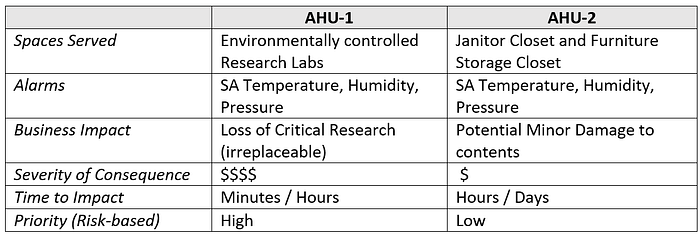
Consider two air handling units that fail at the same time. Both generate alarms, but each event affects a different type of space.
- AHU-1 serves a research lab with temperature-sensitive materials.
- AHU-2 serves a general storage area with noncritical contents.
A weak approach to the management of alarm systems treats these events as equal because the equipment type matches. This adds unnecessary noise, increases alarm overload, and slows operator action during a high-risk moment. A stronger alarm design assigns AHU A the higher priority because the loss of conditioned air in a research lab carries greater consequences and requires a faster response. AHU B still needs attention, but the operational impact is lower.
This scenario reflects the core intent of alarm rationalization within an alarm management lifecycle. Priority communicates what could happen if action is delayed and gives operators a clear basis for response decisions across packaged systems and facility assets.
Common alarm prioritization mistakes
Alarm system management often shifts over time as systems expand and vendors make updates. Without a defined alarm philosophy, priority assignments drift and become harder to trust.
Common issues include:
- Leaving priority fields unused within the control system
- Carrying over vendor default values without review
- Missing documentation that explains why alarms hold specific levels
- Using priority levels to label equipment groups or trade responsibility rather than operator action urgency
- Creating too many priority levels, which weakens alarm system performance
- Assigning a large percentage of alarms to the highest level, which hides high-impact events and increases alarm overload
A practical prioritization model stays simple, reflects real operational conditions, and supports consistent operator action during demanding shifts.
Alarm management best practices
Effective alarm management supports clarity, reduces nuisance alarms, and improves response speed. These practices help teams build a structure that works across shifts and packaged systems.
- Limit priority levels to three or four to keep categories meaningful.
- Keep the highest category small so critical alarms stand out.
- Use consistent naming conventions across monitoring systems to support faster alarm identification.
- Provide sorting and filtering in operator views so high-priority alarms surface quickly within WebTMA or other control environments.
- Review alarm lists on a defined schedule as part of an ongoing alarm management lifecycle.
- Align priority definitions across shifts to maintain continuity.
- Document criteria in a short format operators will reference during real events.
- Combine automation with human oversight to address alarms that fall outside automated logic.
These practices strengthen alarm system performance and help teams maintain steady operations during periods of high alarm frequency.
How Virtual Facility standardizes alarm management
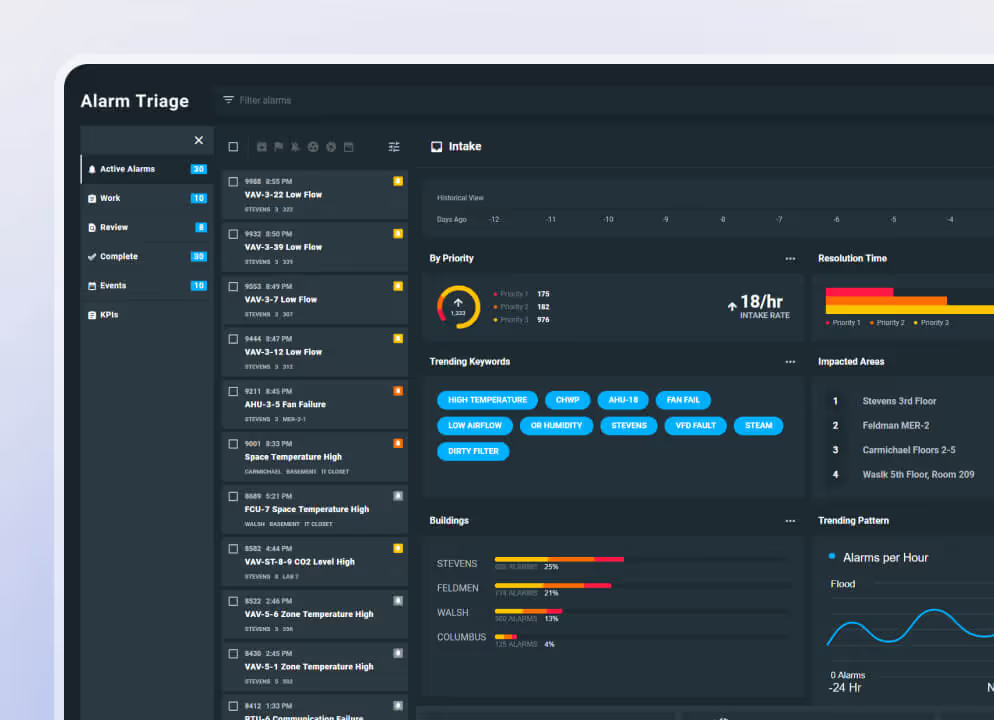
Virtual Facility’s Alarm Triage consolidates alarms from different monitoring systems into one view, which supports stronger management of alarm systems across facilities. The platform applies a unified prioritization structure across all connected BAS and packaged systems. This removes confusion caused by inconsistent alarm design and varying vendor formats.
The model prioritizes events based on operational consequences and time to impact, allowing high-risk alarms to surface faster while reducing low-value noise. Clear formatting and consolidated displays reduce alarm overload and help operators maintain focus during periods of heavy activity. This supports alignment with ISA-18.2 and related alarm management practices and gives teams a stronger foundation for ongoing alarm system management.
The approach improves day-to-day decision-making, supports alarm rationalization efforts, and strengthens longer-term reliability planning when paired with maintenance workflows in WebTMA.
FAQs about alarm management standards and prioritization

Download the eBook now
You’re all set!
Your eBook is on its way to your inbox. We hope it brings fresh insights and practical takeaways to help you get more from your maintenance operations.
Explore related resources
.avif)
Get a practical guide to alarm management standards and smarter prioritization. Reduce downtime risk with clear criteria, examples, and best practices.
Facilities rely on an alarm system to spot issues early and reduce the risk of downtime. Clear standards give operators a consistent way to read urgency and act before conditions escalate. Strong alarm management helps teams handle alarm frequency across shifts, reduce nuisance alarms, and maintain safer, steadier operations.
What are alarm management standards?
Alarm management standards define how alarms are created, prioritized, and interpreted across a facility or process plant. These standards guide alarm system design, support better control system decisions, and give teams a shared structure for reading conditions and responding with confidence.
Standards such as ISA-18.2 outline practical guidelines for alarm creation, documentation, alarm philosophy development, and priority levels. These guidelines help reduce nuisance alarms, maintain process safety, and support more reliable alarm management practices.
Why alarm prioritization matters?
Alarm priority signals how urgent an event is within the alarm system. Clear assignments help operators act on the issues with the highest operational, safety, or compliance impact. A structured prioritization approach gives teams a dependable way to handle high-volume situations in both facilities and process industries.
Poor prioritization increases risk across the control system:
- Too many high-priority alarms hide the issues that carry the greatest impact.
- Limited triage ability slows the response to time-sensitive events.
- Critical alarms blend in and become easier to miss.
- Weak prioritization increases blind spots in operational risk and process safety.
- New operators struggle without a reliable decision path when institutional knowledge is thin.
Consistent alarm prioritization reduces false positives, lowers fatigue, and improves uptime. Operators gain a clear path to the highest-impact events during the moments that matter.
How to tell whether your alarm prioritization is effective
Strong alarm prioritization supports faster action during high-volume events. A simple check reveals whether your current setup reflects real operational risk.
- Pick any two alarms in your system without reviewing their current priority levels.
- Decide which alarm carries the greater consequence if left unaddressed. Focus on operational impact, safety exposure, or the risk of service interruption.
- Compare that assessment to the existing priority assignments. The alarm with the greater consequence should hold the higher priority.
- Repeat this process with additional pairs.
Frequent mismatches signal gaps in your prioritization logic. These gaps slow the operator during active incidents and increase the chance of missing a high-impact event. A priority structure aligned with operational risk and process safety helps operators act quickly during overlapping alarms.
What should alarm priority be based on?
Alarm priority relies on clear criteria. These factors support consistent decision-making across shifts and during abnormal events.
- Severity: Assess how severe the underlying condition is and what the failure affects within the facility or process plant.
- Consequence of inaction: Identify what happens if the alarm sits untouched. Consider financial risk, asset protection, environmental impact, and effects on process safety.
- Time sensitivity: Determine how quickly the condition can escalate. Some alarms require immediate action to prevent equipment shutdowns or process interruptions.
- Safety or compliance impact: Review any safety obligations, environmental controls, or regulated conditions connected to the alarm.
- Operational dependencies: Understand how the issue affects other systems or process units. A failure can escalate across the control system if ignored.
These criteria align with principles in ISA-18.2 and create a strong base for alarm management practices that reduce nuisance alarms and strengthen overall alarm philosophy.
How priority ties into risk management
Alarm priority works as a real-time indicator of operational risk within both facilities and process industries. Clear assignments highlight high-consequence events and conditions that require quick intervention. This helps teams act before issues spread across the control system.
Effective priority assignments support:
- Risk mitigation: Teams see the alarms tied to the highest financial, operational, or process safety impact.
- Compliance: Regulated environments gain faster visibility into alarms tied to environmental or quality constraints.
- Safety planning: Alarms tied to occupant safety or process deviations become easier to identify.
- Resource allocation: Technicians can move toward the highest-impact issues without sorting through noise.
- Faster recovery: Strong prioritization helps teams stabilize equipment and processes faster during multi-alarm events.
Alarm priority reflects consequence and time to impact, which makes it one of the most reliable indicators of urgency in any alarm system or control environment.
Practical example of alarm prioritization
Consider two air handling units that fail at the same time. Both generate alarms, but each event affects a different type of space.
- AHU-1 serves a research lab with temperature-sensitive materials.
- AHU-2 serves a general storage area with noncritical contents.
A weak approach to the management of alarm systems treats these events as equal because the equipment type matches. This adds unnecessary noise, increases alarm overload, and slows operator action during a high-risk moment. A stronger alarm design assigns AHU A the higher priority because the loss of conditioned air in a research lab carries greater consequences and requires a faster response. AHU B still needs attention, but the operational impact is lower.
This scenario reflects the core intent of alarm rationalization within an alarm management lifecycle. Priority communicates what could happen if action is delayed and gives operators a clear basis for response decisions across packaged systems and facility assets.

Common alarm prioritization mistakes
Alarm system management often shifts over time as systems expand and vendors make updates. Without a defined alarm philosophy, priority assignments drift and become harder to trust.
Common issues include:
- Leaving priority fields unused within the control system
- Carrying over vendor default values without review
- Missing documentation that explains why alarms hold specific levels
- Using priority levels to label equipment groups or trade responsibility rather than operator action urgency
- Creating too many priority levels, which weakens alarm system performance
- Assigning a large percentage of alarms to the highest level, which hides high-impact events and increases alarm overload
A practical prioritization model stays simple, reflects real operational conditions, and supports consistent operator action during demanding shifts.
Alarm management best practices
Effective alarm management supports clarity, reduces nuisance alarms, and improves response speed. These practices help teams build a structure that works across shifts and packaged systems.
- Limit priority levels to three or four to keep categories meaningful.
- Keep the highest category small so critical alarms stand out.
- Use consistent naming conventions across monitoring systems to support faster alarm identification.
- Provide sorting and filtering in operator views so high-priority alarms surface quickly within WebTMA or other control environments.
- Review alarm lists on a defined schedule as part of an ongoing alarm management lifecycle.
- Align priority definitions across shifts to maintain continuity.
- Document criteria in a short format operators will reference during real events.
- Combine automation with human oversight to address alarms that fall outside automated logic.
These practices strengthen alarm system performance and help teams maintain steady operations during periods of high alarm frequency.
How Virtual Facility standardizes alarm management
Virtual Facility’s Alarm Triage consolidates alarms from different monitoring systems into one view, which supports stronger management of alarm systems across facilities. The platform applies a unified prioritization structure across all connected BAS and packaged systems. This removes confusion caused by inconsistent alarm design and varying vendor formats.
The model prioritizes events based on operational consequences and time to impact, allowing high-risk alarms to surface faster while reducing low-value noise. Clear formatting and consolidated displays reduce alarm overload and help operators maintain focus during periods of heavy activity. This supports alignment with ISA-18.2 and related alarm management practices and gives teams a stronger foundation for ongoing alarm system management.
The approach improves day-to-day decision-making, supports alarm rationalization efforts, and strengthens longer-term reliability planning when paired with maintenance workflows in WebTMA.
FAQs about alarm management standards and prioritization

Register for your free webinar
You’re all set!
Your webinar is on its way to your inbox. We hope it brings fresh insights and practical takeaways to help you get more from your maintenance operations.
Explore related resources
.avif)
Facilities rely on an alarm system to spot issues early and reduce the risk of downtime. Clear standards give operators a consistent way to read urgency and act before conditions escalate. Strong alarm management helps teams handle alarm frequency across shifts, reduce nuisance alarms, and maintain safer, steadier operations.
What are alarm management standards?
Alarm management standards define how alarms are created, prioritized, and interpreted across a facility or process plant. These standards guide alarm system design, support better control system decisions, and give teams a shared structure for reading conditions and responding with confidence.
Standards such as ISA-18.2 outline practical guidelines for alarm creation, documentation, alarm philosophy development, and priority levels. These guidelines help reduce nuisance alarms, maintain process safety, and support more reliable alarm management practices.
Why alarm prioritization matters?
Alarm priority signals how urgent an event is within the alarm system. Clear assignments help operators act on the issues with the highest operational, safety, or compliance impact. A structured prioritization approach gives teams a dependable way to handle high-volume situations in both facilities and process industries.
Poor prioritization increases risk across the control system:
- Too many high-priority alarms hide the issues that carry the greatest impact.
- Limited triage ability slows the response to time-sensitive events.
- Critical alarms blend in and become easier to miss.
- Weak prioritization increases blind spots in operational risk and process safety.
- New operators struggle without a reliable decision path when institutional knowledge is thin.
Consistent alarm prioritization reduces false positives, lowers fatigue, and improves uptime. Operators gain a clear path to the highest-impact events during the moments that matter.
How to tell whether your alarm prioritization is effective
Strong alarm prioritization supports faster action during high-volume events. A simple check reveals whether your current setup reflects real operational risk.
- Pick any two alarms in your system without reviewing their current priority levels.
- Decide which alarm carries the greater consequence if left unaddressed. Focus on operational impact, safety exposure, or the risk of service interruption.
- Compare that assessment to the existing priority assignments. The alarm with the greater consequence should hold the higher priority.
- Repeat this process with additional pairs.
Frequent mismatches signal gaps in your prioritization logic. These gaps slow the operator during active incidents and increase the chance of missing a high-impact event. A priority structure aligned with operational risk and process safety helps operators act quickly during overlapping alarms.
What should alarm priority be based on?
Alarm priority relies on clear criteria. These factors support consistent decision-making across shifts and during abnormal events.
- Severity: Assess how severe the underlying condition is and what the failure affects within the facility or process plant.
- Consequence of inaction: Identify what happens if the alarm sits untouched. Consider financial risk, asset protection, environmental impact, and effects on process safety.
- Time sensitivity: Determine how quickly the condition can escalate. Some alarms require immediate action to prevent equipment shutdowns or process interruptions.
- Safety or compliance impact: Review any safety obligations, environmental controls, or regulated conditions connected to the alarm.
- Operational dependencies: Understand how the issue affects other systems or process units. A failure can escalate across the control system if ignored.
These criteria align with principles in ISA-18.2 and create a strong base for alarm management practices that reduce nuisance alarms and strengthen overall alarm philosophy.
How priority ties into risk management
Alarm priority works as a real-time indicator of operational risk within both facilities and process industries. Clear assignments highlight high-consequence events and conditions that require quick intervention. This helps teams act before issues spread across the control system.
Effective priority assignments support:
- Risk mitigation: Teams see the alarms tied to the highest financial, operational, or process safety impact.
- Compliance: Regulated environments gain faster visibility into alarms tied to environmental or quality constraints.
- Safety planning: Alarms tied to occupant safety or process deviations become easier to identify.
- Resource allocation: Technicians can move toward the highest-impact issues without sorting through noise.
- Faster recovery: Strong prioritization helps teams stabilize equipment and processes faster during multi-alarm events.
Alarm priority reflects consequence and time to impact, which makes it one of the most reliable indicators of urgency in any alarm system or control environment.
Practical example of alarm prioritization
Consider two air handling units that fail at the same time. Both generate alarms, but each event affects a different type of space.
- AHU-1 serves a research lab with temperature-sensitive materials.
- AHU-2 serves a general storage area with noncritical contents.
A weak approach to the management of alarm systems treats these events as equal because the equipment type matches. This adds unnecessary noise, increases alarm overload, and slows operator action during a high-risk moment. A stronger alarm design assigns AHU A the higher priority because the loss of conditioned air in a research lab carries greater consequences and requires a faster response. AHU B still needs attention, but the operational impact is lower.
This scenario reflects the core intent of alarm rationalization within an alarm management lifecycle. Priority communicates what could happen if action is delayed and gives operators a clear basis for response decisions across packaged systems and facility assets.

Common alarm prioritization mistakes
Alarm system management often shifts over time as systems expand and vendors make updates. Without a defined alarm philosophy, priority assignments drift and become harder to trust.
Common issues include:
- Leaving priority fields unused within the control system
- Carrying over vendor default values without review
- Missing documentation that explains why alarms hold specific levels
- Using priority levels to label equipment groups or trade responsibility rather than operator action urgency
- Creating too many priority levels, which weakens alarm system performance
- Assigning a large percentage of alarms to the highest level, which hides high-impact events and increases alarm overload
A practical prioritization model stays simple, reflects real operational conditions, and supports consistent operator action during demanding shifts.
Alarm management best practices
Effective alarm management supports clarity, reduces nuisance alarms, and improves response speed. These practices help teams build a structure that works across shifts and packaged systems.
- Limit priority levels to three or four to keep categories meaningful.
- Keep the highest category small so critical alarms stand out.
- Use consistent naming conventions across monitoring systems to support faster alarm identification.
- Provide sorting and filtering in operator views so high-priority alarms surface quickly within WebTMA or other control environments.
- Review alarm lists on a defined schedule as part of an ongoing alarm management lifecycle.
- Align priority definitions across shifts to maintain continuity.
- Document criteria in a short format operators will reference during real events.
- Combine automation with human oversight to address alarms that fall outside automated logic.
These practices strengthen alarm system performance and help teams maintain steady operations during periods of high alarm frequency.
How Virtual Facility standardizes alarm management
Virtual Facility’s Alarm Triage consolidates alarms from different monitoring systems into one view, which supports stronger management of alarm systems across facilities. The platform applies a unified prioritization structure across all connected BAS and packaged systems. This removes confusion caused by inconsistent alarm design and varying vendor formats.
The model prioritizes events based on operational consequences and time to impact, allowing high-risk alarms to surface faster while reducing low-value noise. Clear formatting and consolidated displays reduce alarm overload and help operators maintain focus during periods of heavy activity. This supports alignment with ISA-18.2 and related alarm management practices and gives teams a stronger foundation for ongoing alarm system management.
The approach improves day-to-day decision-making, supports alarm rationalization efforts, and strengthens longer-term reliability planning when paired with maintenance workflows in WebTMA.
FAQs about alarm management standards and prioritization
Related resources
Related resources
You’ve seen what’s possible—connect with us to learn how TMA Systems can support your goals beyond the event.
You’ve read the insights, now see how TMA Systems helps teams put them into practice.


From ideas to impact
You’ve read the insights, now see how TMA Systems helps teams put them into practice.


From screen to solution
You’ve watched what’s possible, now see how TMA Systems works for your organization.


From insight to implementation
You’ve explored the strategies, now see how we can bring them to life across your real facilities.


From insight to implementation
You’ve explored the strategies, now see how we can bring them to life across your real facilities.


.avif)