Resources
Blog
Preventive maintenance program guide for 2026
Blog
February 25, 2026
5
 min read

Preventive maintenance program guide for 2026

Preventive maintenance program guide for 2026

In this post

1
A preventive maintenance program governs strategy, planning, execution, and technology across your entire asset base.
2
Program design must reflect your industry's operational demands, compliance obligations, and asset complexity.
3
The right CMMS or EAM platform, implemented with clear governance, is what separates a program that scales from one that drifts.
By the numbers

1

A preventive maintenance program governs strategy, planning, execution, and technology across your entire asset base.

2

Program design must reflect your industry's operational demands, compliance obligations, and asset complexity.

3

The right CMMS or EAM platform, implemented with clear governance, is what separates a program that scales from one that drifts.
Resources
eBooks & Whitepapers
Preventive maintenance program guide for 2026
Blog
Preventive maintenance program guide for 2026

Learn how to build a preventive maintenance program. Explore industry requirements, key steps, and system considerations for 2026.

Running a solid preventive maintenance program has always taken discipline. In 2026, it takes more than that. Facilities teams are managing older infrastructure with leaner crews, facing tighter compliance scrutiny, and being asked to do more with budgets that haven't kept pace with operational demands. Reactive maintenance still happens, but organizations that rely on it as a default are paying for it in unplanned downtime, emergency labor costs, and equipment that wears out faster than it should.

A structured approach, supported by the right preventive maintenance software, gives teams the visibility and control to stay ahead of failures, manage costs predictably, and withstand audits.

What is a preventive maintenance program?

Preventive maintenance is scheduled, condition-based, or usage-triggered work performed on assets before they fail. A preventive maintenance program is the organizational framework that governs how that work gets planned, assigned, executed, documented, and measured across your entire asset base. It spans people, processes, and technology and operates at a level above individual work orders or maintenance schedules.

The table below clarifies how the term sits alongside concepts that are often used interchangeably.

Concept Definition How It Differs
Preventive maintenance program The organizational framework governing how preventive maintenance is planned, executed, tracked, and improved across an asset base. Operates at the organizational level and encompasses strategy, tools, and accountability structures.
Preventive maintenance plan A documented schedule of specific maintenance tasks for a defined asset or asset group. Tactical and asset-specific; one component within the broader program.
Preventive maintenance strategy The decision framework for how an organization prioritizes and approaches asset care, including risk tolerance and resource allocation. Informs the program’s design and guides decisions about frequency, method, and priority.
Preventive maintenance checklist A standardized task list used to execute and document a specific maintenance activity. An operational tool used at the point of execution, not a program management document.
Preventive maintenance software Technology purpose-built to schedule, automate, and track preventive maintenance tasks, asset records, and compliance documentation. Differs from general CMMS in its focus on PM-specific workflows and functions as the execution layer within a broader program.
CMMS software A computerized maintenance management system used to schedule, track, and report on maintenance work and assets. Technology that supports program execution but does not replace the governance structure around it.
Reactive maintenance Unplanned repair work performed after an asset has already failed or degraded. The default without a structured program; higher cost and lower predictability than reactive vs. preventive maintenance approaches.

Organizations with mature programs use enterprise asset management software to connect asset data, maintenance history, cost tracking, and compliance documentation in a single system. That integration matters because a program that exists only in spreadsheets or the minds of experienced technicians is fragile. When those technicians leave, or an auditor requests records, the gaps become costly problems.

A preventive maintenance program governs the full picture: the strategy behind the decisions, the plans that carry them out, the tools that support execution, and the data that proves it's working. The checklist below captures what that program needs to cover in practice.

Preventive maintenance checklist: what every program should include

A preventive maintenance checklist translates program intent into repeatable, auditable action. Where the program sets direction, the checklist operationalizes it at the task level. Maintenance managers use checklists to standardize execution across technicians, shifts, and sites so that work gets done the same way every time, regardless of who's doing it.

Every well-run preventive maintenance program should account for the following:

  • Asset inventory completeness: All maintainable assets are identified, documented, and assigned unique records. Equipment without a record cannot be scheduled, tracked, or protected from equipment failure.
  • Risk ranking methodology: Assets are prioritized based on operational criticality, safety exposure, and failure consequence. High-criticality assets receive tighter scheduling tolerances and closer monitoring to reduce the risk of equipment failure that disrupts operations.
  • Task standardization: Maintenance services are defined in written procedures and applied consistently across time-based maintenance and usage-based maintenance models.
  • Scheduling logic: Maintenance triggers are defined using calendar intervals, runtime hours, meter readings, or condition indicators. A preventive maintenance schedule should reflect actual asset demand, supported by real-time data where available, rather than default intervals carried forward without review.
  • Parts and labor allocation: Required parts and labor hours are identified at the work order level before the job is placed on the maintenance calendar. Technicians arrive prepared, reducing delays and limiting the likelihood of secondary equipment failure caused by incomplete work.
  • Documentation standards: Technicians record findings, corrective actions, and parts usage. Reliable records extend asset lifespan and help identify patterns that may justify a shift toward predictive maintenance.
  • Audit tracking: Inspection and compliance records are stored in a retrievable format with timestamps and technician attribution. This protects the organization during audits and validates that preventive maintenance services are performed as scheduled.
  • Reporting cadence: Program performance is reviewed on a defined schedule. Metrics such as PM compliance rate, mean time between failures, and backlog volume help maintenance leaders adjust the preventive maintenance schedule before minor issues escalate into costly repairs.
  • CMMS governance: The maintenance system has a defined owner and clear data standards. Governance keeps real-time data accurate and supports long-term reliability analysis.

A preventive maintenance checklist operationalizes the broader preventive maintenance program. It provides a structured way to align preventive maintenance schedules, maintenance services, and documentation so assets operate reliably and consistently. The next section examines how those requirements shift by industry, because operational context shapes how each element is prioritized.

Preventive maintenance requirements by industry

Program design varies by industry, and those differences are operational, not cosmetic. The compliance obligations, asset profiles, and failure consequences vary enough across industries that a program structure that works in one environment can leave serious gaps in another. A program built without that context tends to miss the riskiest areas.

The table below outlines how preventive maintenance requirements shift by industry, and what that means for program structure and execution.

Industry Specific Operational Needs Preventive Maintenance Program Implications
Healthcare Regulatory compliance, patient safety, equipment validation, biomedical asset oversight Detailed documentation standards, calibration tracking, audit-ready records, strict scheduling controls tied to clinical and accreditation requirements
Education Aging building stock, seasonal occupancy shifts, deferred maintenance backlogs, life safety system compliance Scheduled inspections aligned to academic calendars, life safety tracking, capital planning support for aging infrastructure, work order visibility across distributed campuses
Manufacturing Equipment uptime, production line dependencies, parts availability, safety inspection requirements Asset hierarchy structured by process and equipment class, integrated inventory control, pre-start and safety inspection workflows, scheduling tied to production demand
Commercial Real Estate Tenant satisfaction, multi-building portfolios, lease compliance, energy performance Portfolio-level reporting, space and equipment tracking across properties, vendor coordination, maintenance cost visibility by asset and location
Utilities & Energy Critical infrastructure reliability, regulatory reporting, remote asset management, safety compliance Rigorous PM scheduling for high-consequence assets, compliance documentation, mobile and offline work execution for field technicians, long asset lifecycle tracking
Government & Public Sector Public accountability, budget constraints, security requirements, multi-site facility management Standardized workflows across facilities, audit-ready records, capital planning support, compliance reporting aligned to federal and state requirements

Programs built around actual industry requirements consistently produce better data, fewer failures, and stronger audit outcomes. The next section walks through how to build that structure from the ground up.

How to create a preventive maintenance program

Knowing what a preventive maintenance program should cover is straightforward on paper. Operationalizing it under daily pressure, competing priorities, and limited resources is where most programs stall. The five steps below provide a practical framework for moving from intent to execution, whether you're formalizing a program for the first time or rebuilding one that has drifted.

1. Define objectives and success metrics 

Before scheduling a single work order, clarify what the program is supposed to accomplish. Reduced unexpected downtime, improved PM completion rates, lower maintenance costs per asset, and stronger audit readiness are all measurable outcomes. They give the program direction and give leadership a way to evaluate whether it's working. Without defined metrics, programs stay busy but don't become more effective. Set a baseline, identify targets, and agree on how performance will be reviewed and who will be responsible for acting on it.

2. Assess assets and prioritize by risk 

Not every asset warrants the same maintenance frequency or attention. A structured asset assessment identifies what you're maintaining, where each asset sits in the operational hierarchy, and what failure actually costs in terms of safety exposure, production impact, compliance risk, and repair spend. High-criticality assets get tighter schedules and more rigorous documentation requirements. Lower-risk assets can run for longer periods without significant operational consequences. Prioritization keeps a program focused on what matters rather than spreading thin across everything equally.

3. Standardize procedures and schedules 

Inconsistent execution is one of the most common reasons preventive maintenance programs produce unreliable data. When technicians perform the same task differently depending on shift, site, or experience level, the records are hard to compare and harder to act on. Standardized procedures define what gets done, in what sequence, and what gets documented. Schedules should reflect actual asset demand, whether calendar-based, runtime-triggered, or condition-driven, rather than arbitrary intervals inherited from a previous system.

4. Establish accountability and reporting 

A preventive maintenance program without clear ownership erodes quietly. Define who maintains the asset library, who reviews PM completion rates, and who is responsible for acting when the backlog grows or repeat failures appear on the same asset. That role clarity keeps the program from becoming everyone's responsibility in theory and no one's in practice. Regular reviews of key metrics matter equally, keeping the program visible to leadership and giving maintenance managers the information they need to adjust priorities before deferred work compounds into more expensive work.

5. Use CMMS/EAM software to scale and sustain

Manual processes can support a small program across a limited asset base, but they don't hold up as asset counts grow, sites multiply, or compliance requirements tighten. At that point, the administrative burden of running a preventive maintenance program without software becomes a real liability.

Reviewing the best CMMS software options helps maintenance leaders understand what structured execution looks like at scale, with automated scheduling, mobile work order access, inventory integration, and audit-ready documentation built into daily workflows. For organizations managing complex asset portfolios or multiple facilities, evaluating the best enterprise asset management software adds asset lifecycle visibility, capital planning support, and cross-site reporting to the program's foundation.

Integration matters here, too. A CMMS that connects to ERP systems, purchasing workflows, inventory platforms, and alarm feeds gives maintenance teams far more operational control than one that operates in isolation. Parts availability, purchase order status, and equipment alerts are all visible within the same system that manages work orders, reducing manual coordination that can create gaps in program execution.

Data migration should also be explicitly planned. Moving asset records, maintenance histories, and open work orders from a legacy system or spreadsheet environment into a new platform introduces risk if it's treated as an afterthought. Incomplete or miscategorized historical data undermines the reporting and reliability analysis on which the program depends from day one.

Getting implementation right from the start protects the program's long-term performance. The next section covers where programs commonly break down, which is just as important to understand as how to build them.

Ready to operationalize your preventive maintenance framework?
Speak with our team to align objectives, risk prioritization, and system strategy to your organization’s needs.

Common preventive maintenance program failures

Most preventive maintenance programs don’t break down due to a lack of intent. They weaken when structural issues accumulate and disconnect the preventive maintenance schedule from daily execution. A system launch without proper rollout planning, unclear ownership, or weak training can undermine a program before it stabilizes. Recognizing these patterns early protects asset lifespan and limits exposure to costly repairs.

  • Incomplete asset inventory: A program can only manage what exists in the system. Missing or outdated records distort the preventive maintenance schedule, leaving assets exposed to equipment failure. When inventory data is unreliable, maintenance services become reactive instead of planned.
  • Overloaded scheduling: Setting the maximum frequency for every asset creates an unrealistic maintenance calendar. When technicians can’t complete assigned work, compliance rates fall, and the preventive maintenance schedule loses credibility. Intervals should reflect risk and capacity, whether using time-based maintenance, usage-based maintenance, or a combination of both.
  • Technician resistance: Slow systems, unclear workflows, or excessive data entry requirements drive workarounds. Paper notes and skipped fields reduce the quality of real-time data and make predictive maintenance difficult to support.
  • Underestimating change management: Moving from reactive work to a structured preventive maintenance schedule requires clarity and follow-through. Technicians and supervisors must understand how their documentation supports asset lifespan and reduces equipment failure. Without that understanding, adoption fades over time.
  • Poor data governance: Asset records drift when no one maintains them. Over time, unreliable data weakens reporting, hides early warning signs, and limits the ability to use real-time data to prevent costly repairs.
  • Lack of executive oversight: When leadership stops reviewing preventive maintenance metrics, staffing, and budget decisions shift toward reactive priorities. Reduced oversight cuts into equipment longevity and increases the likelihood of equipment failure during peak demand.
  • No integration between alarms, calibration, and CMMS: When alarm feeds, calibration systems, and work orders operate separately, early warning signals remain isolated. Real-time data that could prevent equipment failure goes unused. This fragmentation undermines predictive maintenance efforts and increases the risk of costly repairs.

Preventive maintenance programs rarely fail in a single event. They decline through small disconnects between schedule, execution, and oversight. Addressing these gaps early keeps assets running smoothly and protects long-term performance.

How to measure preventive maintenance program effectiveness

A preventive maintenance program can look productive on the surface while losing ground operationally. Schedules are followed, work orders get closed, and the dashboard looks fine, yet unplanned failures keep happening, and costs keep rising. The KPI (key performance indicator) metrics below give maintenance managers and executives a clearer view of what's actually working. They’re also the same metrics that credible CMMS software should consistently surface in its reporting.

Metric What It Indicates Why Leadership Cares
PM compliance rate Percentage of scheduled preventive maintenance tasks completed on time Low compliance signals scheduling problems, labor gaps, or technician adoption issues before they become failures
Unplanned downtime % Share of total downtime attributed to unplanned failures Directly tied to production loss, emergency labor costs, and operational risk exposure
Mean time between failure (MTBF) Average operating time between asset failures Rising MTBF indicates the program is extending asset reliability; declining MTBF warrants review of maintenance frequency and procedures
Maintenance cost per asset Total maintenance spend divided across the asset base Identifies high-cost assets that may require replacement, procedure adjustment, or deeper reliability analysis
Work order backlog trend Volume of open, overdue, or deferred work orders over time A growing backlog indicates the program is generating more demand than the team can execute, increasing failure risk
Asset lifecycle cost trend Cumulative maintenance, repair, and operational costs tracked over an asset's life Supports capital planning decisions and helps determine when repair costs justify replacement
Audit findings Number and severity of compliance gaps identified during internal or external audits Reflects documentation quality, scheduling discipline, and reliability of maintenance records under scrutiny

These metrics depend on the quality of the data behind them. CMMS reporting surfaces accurate numbers when asset records are complete, work orders are closed with full documentation, and technicians are entering data in the system rather than working around it. Data governance and technician adoption shape what leadership sees when they open a report and whether those numbers are worth acting on. Organizations that review operational metrics monthly and lifecycle or cost trends quarterly build the kind of visibility that turns program adjustments from reactive responses into deliberate decisions.

How TMA Systems supports structured preventive maintenance

A well-designed preventive maintenance program still needs the right platform behind it. TMA Systems offers a portfolio of configurable solutions for organizations at different levels of complexity, from mid-market industrial operations to large multi-site enterprises with formal compliance and governance requirements.

  • WebTMA is TMA's enterprise CMMS and asset management platform, built for complex, multi-site organizations that require structured preventive maintenance scheduling, asset lifecycle tracking, compliance documentation, and centralized reporting. It supports facilities teams managing large asset portfolios where governance, audit readiness, and capital planning are operational priorities alongside day-to-day maintenance execution. WebTMA also supports integration with ERP, purchasing, and inventory systems, keeping maintenance data connected to the financial and operational systems that leadership depends on.
  • MEX CMMS is designed for mid-market organizations managing equipment-centric asset bases where technician adoption and execution speed directly affect program outcomes. It delivers structured preventive maintenance workflows, integrated parts and inventory control, and mobile offline capability for teams working in plants, yards, or field environments where connectivity isn't reliable.
  • EQ2 HEMS is a purpose-built CMMS for healthcare environments where hospital or biomedical equipment maintenance, calibration tracking, and regulatory compliance documentation carry direct patient safety implications. It supports hospital facilities teams in maintaining audit-ready records and scheduling controls aligned to clinical accreditation requirements.
  • Virtual Facility is an alarm monitoring solution that centralizes and prioritizes facility alerts. It works in conjunction with a CMMS or EAM platform to connect alarm data to maintenance workflows, reducing the gap between an early warning signal and a work order response.
  • ProCal and ProCalX provide calibration management for regulated environments where instrument accuracy and traceability are compliance requirements. These solutions integrate with CMMS and EAM platforms to bring calibration records into the broader maintenance and audit documentation structure.

Preventive maintenance programs succeed when the tools supporting them are configured to match the organization's actual asset base, compliance obligations, and operational structure. 

TMA Systems brings implementation experience across industries and organizational scales. That means the support doesn't stop at software deployment. From data migration planning and system configuration to technician training and long-term program governance, the goal is a program that works in practice, holds up under scrutiny, and evolves as the organization's needs change.

Preventive maintenance programs succeed when the tools supporting them are configured to match the organization's actual asset base, compliance obligations, and operational structure. 

TMA Systems brings implementation experience across industries and organizational scales. That means the support doesn't stop at software deployment. From data migration planning and system configuration to technician training and long-term program governance, the goal is a program that works in practice, holds up under scrutiny, and evolves as the organization's needs change.

Ready to strengthen your preventive maintenance program?
Explore how TMA Systems' configurable platforms support execution, oversight, and long-term reliability.

FAQs about preventive maintenance programs

What is the difference between a preventive maintenance program and a preventive maintenance plan?

A preventive maintenance program is the overarching framework that defines how maintenance is structured, resourced, executed, and measured across the asset base.

A preventive maintenance plan is asset-specific. It outlines the tasks, frequency, and conditions for a particular piece of equipment. Multiple plans can operate under a single program that sets standards, governs data, and tracks performance.

Which industries require the most structured preventive maintenance programs?

Healthcare, manufacturing, utilities, and government facilities typically require the most structure.

Healthcare must meet strict biomedical and accreditation standards. Manufacturing depends on uptime for revenue. Utilities manage high-consequence infrastructure. Government facilities operate under public accountability and audit scrutiny. In each case, documentation and scheduling discipline are critical.

What role does CMMS or EAM software play in preventive maintenance?

CMMS software manages scheduling, work orders, parts, labor tracking, and maintenance documentation.

As asset counts grow, manual tracking creates gaps. EAM software extends visibility into lifecycle cost, capital planning, and cross-site performance. Together, these systems support consistent execution and reliable reporting.

How long does it take to implement a preventive maintenance program?

The timeline depends on organizational complexity and data quality.

A mid-market organization moving from spreadsheets to a CMMS may complete implementation in six to sixteen weeks if asset records are clean and ownership is defined early. Multi-site or regulated environments typically require more time. Data cleanup is the most common factor that extends implementation.

What are the most common mistakes in preventive maintenance program implementation?

Common mistakes include starting without a complete asset inventory, applying uniform maintenance frequency regardless of risk, and launching a system without technician training.

Programs also weaken when no one owns the data after go-live. Clear ownership, realistic scheduling, and structured rollout planning are essential.

How does TMA Systems support the execution of the preventive maintenance program?

TMA Systems provides configurable platforms for enterprise, mid-market, and healthcare environments.

WebTMA, MEX CMMS, and EQ2 HEMS support scheduling, work order management, asset tracking, and compliance documentation. Implementation guidance, data migration planning, and ongoing governance support help organizations build programs that perform operationally and withstand regulatory review.

Key Insights You'll Gain:
  • A preventive maintenance program governs strategy, planning, execution, and technology across your entire asset base.
  • Program design must reflect your industry's operational demands, compliance obligations, and asset complexity.
  • The right CMMS or EAM platform, implemented with clear governance, is what separates a program that scales from one that drifts.

Download the eBook now

You’re all set!

Your eBook is on its way to your inbox. We hope it brings fresh insights and practical takeaways to help you get more from your maintenance operations.

Explore related resources

Resources
Blog
Preventive maintenance program guide for 2026
Resources
eBooks & Whitepapers
Preventive maintenance program guide for 2026
Blog
Preventive maintenance program guide for 2026

Learn how to build a preventive maintenance program. Explore industry requirements, key steps, and system considerations for 2026.

February 25, 2026

Running a solid preventive maintenance program has always taken discipline. In 2026, it takes more than that. Facilities teams are managing older infrastructure with leaner crews, facing tighter compliance scrutiny, and being asked to do more with budgets that haven't kept pace with operational demands. Reactive maintenance still happens, but organizations that rely on it as a default are paying for it in unplanned downtime, emergency labor costs, and equipment that wears out faster than it should.

A structured approach, supported by the right preventive maintenance software, gives teams the visibility and control to stay ahead of failures, manage costs predictably, and withstand audits.

What is a preventive maintenance program?

Preventive maintenance is scheduled, condition-based, or usage-triggered work performed on assets before they fail. A preventive maintenance program is the organizational framework that governs how that work gets planned, assigned, executed, documented, and measured across your entire asset base. It spans people, processes, and technology and operates at a level above individual work orders or maintenance schedules.

The table below clarifies how the term sits alongside concepts that are often used interchangeably.

Concept Definition How It Differs
Preventive maintenance program The organizational framework governing how preventive maintenance is planned, executed, tracked, and improved across an asset base. Operates at the organizational level and encompasses strategy, tools, and accountability structures.
Preventive maintenance plan A documented schedule of specific maintenance tasks for a defined asset or asset group. Tactical and asset-specific; one component within the broader program.
Preventive maintenance strategy The decision framework for how an organization prioritizes and approaches asset care, including risk tolerance and resource allocation. Informs the program’s design and guides decisions about frequency, method, and priority.
Preventive maintenance checklist A standardized task list used to execute and document a specific maintenance activity. An operational tool used at the point of execution, not a program management document.
Preventive maintenance software Technology purpose-built to schedule, automate, and track preventive maintenance tasks, asset records, and compliance documentation. Differs from general CMMS in its focus on PM-specific workflows and functions as the execution layer within a broader program.
CMMS software A computerized maintenance management system used to schedule, track, and report on maintenance work and assets. Technology that supports program execution but does not replace the governance structure around it.
Reactive maintenance Unplanned repair work performed after an asset has already failed or degraded. The default without a structured program; higher cost and lower predictability than reactive vs. preventive maintenance approaches.

Organizations with mature programs use enterprise asset management software to connect asset data, maintenance history, cost tracking, and compliance documentation in a single system. That integration matters because a program that exists only in spreadsheets or the minds of experienced technicians is fragile. When those technicians leave, or an auditor requests records, the gaps become costly problems.

A preventive maintenance program governs the full picture: the strategy behind the decisions, the plans that carry them out, the tools that support execution, and the data that proves it's working. The checklist below captures what that program needs to cover in practice.

Preventive maintenance checklist: what every program should include

A preventive maintenance checklist translates program intent into repeatable, auditable action. Where the program sets direction, the checklist operationalizes it at the task level. Maintenance managers use checklists to standardize execution across technicians, shifts, and sites so that work gets done the same way every time, regardless of who's doing it.

Every well-run preventive maintenance program should account for the following:

  • Asset inventory completeness: All maintainable assets are identified, documented, and assigned unique records. Equipment without a record cannot be scheduled, tracked, or protected from equipment failure.
  • Risk ranking methodology: Assets are prioritized based on operational criticality, safety exposure, and failure consequence. High-criticality assets receive tighter scheduling tolerances and closer monitoring to reduce the risk of equipment failure that disrupts operations.
  • Task standardization: Maintenance services are defined in written procedures and applied consistently across time-based maintenance and usage-based maintenance models.
  • Scheduling logic: Maintenance triggers are defined using calendar intervals, runtime hours, meter readings, or condition indicators. A preventive maintenance schedule should reflect actual asset demand, supported by real-time data where available, rather than default intervals carried forward without review.
  • Parts and labor allocation: Required parts and labor hours are identified at the work order level before the job is placed on the maintenance calendar. Technicians arrive prepared, reducing delays and limiting the likelihood of secondary equipment failure caused by incomplete work.
  • Documentation standards: Technicians record findings, corrective actions, and parts usage. Reliable records extend asset lifespan and help identify patterns that may justify a shift toward predictive maintenance.
  • Audit tracking: Inspection and compliance records are stored in a retrievable format with timestamps and technician attribution. This protects the organization during audits and validates that preventive maintenance services are performed as scheduled.
  • Reporting cadence: Program performance is reviewed on a defined schedule. Metrics such as PM compliance rate, mean time between failures, and backlog volume help maintenance leaders adjust the preventive maintenance schedule before minor issues escalate into costly repairs.
  • CMMS governance: The maintenance system has a defined owner and clear data standards. Governance keeps real-time data accurate and supports long-term reliability analysis.

A preventive maintenance checklist operationalizes the broader preventive maintenance program. It provides a structured way to align preventive maintenance schedules, maintenance services, and documentation so assets operate reliably and consistently. The next section examines how those requirements shift by industry, because operational context shapes how each element is prioritized.

Preventive maintenance requirements by industry

Program design varies by industry, and those differences are operational, not cosmetic. The compliance obligations, asset profiles, and failure consequences vary enough across industries that a program structure that works in one environment can leave serious gaps in another. A program built without that context tends to miss the riskiest areas.

The table below outlines how preventive maintenance requirements shift by industry, and what that means for program structure and execution.

Industry Specific Operational Needs Preventive Maintenance Program Implications
Healthcare Regulatory compliance, patient safety, equipment validation, biomedical asset oversight Detailed documentation standards, calibration tracking, audit-ready records, strict scheduling controls tied to clinical and accreditation requirements
Education Aging building stock, seasonal occupancy shifts, deferred maintenance backlogs, life safety system compliance Scheduled inspections aligned to academic calendars, life safety tracking, capital planning support for aging infrastructure, work order visibility across distributed campuses
Manufacturing Equipment uptime, production line dependencies, parts availability, safety inspection requirements Asset hierarchy structured by process and equipment class, integrated inventory control, pre-start and safety inspection workflows, scheduling tied to production demand
Commercial Real Estate Tenant satisfaction, multi-building portfolios, lease compliance, energy performance Portfolio-level reporting, space and equipment tracking across properties, vendor coordination, maintenance cost visibility by asset and location
Utilities & Energy Critical infrastructure reliability, regulatory reporting, remote asset management, safety compliance Rigorous PM scheduling for high-consequence assets, compliance documentation, mobile and offline work execution for field technicians, long asset lifecycle tracking
Government & Public Sector Public accountability, budget constraints, security requirements, multi-site facility management Standardized workflows across facilities, audit-ready records, capital planning support, compliance reporting aligned to federal and state requirements

Programs built around actual industry requirements consistently produce better data, fewer failures, and stronger audit outcomes. The next section walks through how to build that structure from the ground up.

How to create a preventive maintenance program

Knowing what a preventive maintenance program should cover is straightforward on paper. Operationalizing it under daily pressure, competing priorities, and limited resources is where most programs stall. The five steps below provide a practical framework for moving from intent to execution, whether you're formalizing a program for the first time or rebuilding one that has drifted.

1. Define objectives and success metrics 

Before scheduling a single work order, clarify what the program is supposed to accomplish. Reduced unexpected downtime, improved PM completion rates, lower maintenance costs per asset, and stronger audit readiness are all measurable outcomes. They give the program direction and give leadership a way to evaluate whether it's working. Without defined metrics, programs stay busy but don't become more effective. Set a baseline, identify targets, and agree on how performance will be reviewed and who will be responsible for acting on it.

2. Assess assets and prioritize by risk 

Not every asset warrants the same maintenance frequency or attention. A structured asset assessment identifies what you're maintaining, where each asset sits in the operational hierarchy, and what failure actually costs in terms of safety exposure, production impact, compliance risk, and repair spend. High-criticality assets get tighter schedules and more rigorous documentation requirements. Lower-risk assets can run for longer periods without significant operational consequences. Prioritization keeps a program focused on what matters rather than spreading thin across everything equally.

3. Standardize procedures and schedules 

Inconsistent execution is one of the most common reasons preventive maintenance programs produce unreliable data. When technicians perform the same task differently depending on shift, site, or experience level, the records are hard to compare and harder to act on. Standardized procedures define what gets done, in what sequence, and what gets documented. Schedules should reflect actual asset demand, whether calendar-based, runtime-triggered, or condition-driven, rather than arbitrary intervals inherited from a previous system.

4. Establish accountability and reporting 

A preventive maintenance program without clear ownership erodes quietly. Define who maintains the asset library, who reviews PM completion rates, and who is responsible for acting when the backlog grows or repeat failures appear on the same asset. That role clarity keeps the program from becoming everyone's responsibility in theory and no one's in practice. Regular reviews of key metrics matter equally, keeping the program visible to leadership and giving maintenance managers the information they need to adjust priorities before deferred work compounds into more expensive work.

5. Use CMMS/EAM software to scale and sustain

Manual processes can support a small program across a limited asset base, but they don't hold up as asset counts grow, sites multiply, or compliance requirements tighten. At that point, the administrative burden of running a preventive maintenance program without software becomes a real liability.

Reviewing the best CMMS software options helps maintenance leaders understand what structured execution looks like at scale, with automated scheduling, mobile work order access, inventory integration, and audit-ready documentation built into daily workflows. For organizations managing complex asset portfolios or multiple facilities, evaluating the best enterprise asset management software adds asset lifecycle visibility, capital planning support, and cross-site reporting to the program's foundation.

Integration matters here, too. A CMMS that connects to ERP systems, purchasing workflows, inventory platforms, and alarm feeds gives maintenance teams far more operational control than one that operates in isolation. Parts availability, purchase order status, and equipment alerts are all visible within the same system that manages work orders, reducing manual coordination that can create gaps in program execution.

Data migration should also be explicitly planned. Moving asset records, maintenance histories, and open work orders from a legacy system or spreadsheet environment into a new platform introduces risk if it's treated as an afterthought. Incomplete or miscategorized historical data undermines the reporting and reliability analysis on which the program depends from day one.

Getting implementation right from the start protects the program's long-term performance. The next section covers where programs commonly break down, which is just as important to understand as how to build them.

Ready to operationalize your preventive maintenance framework?
Speak with our team to align objectives, risk prioritization, and system strategy to your organization’s needs.

Common preventive maintenance program failures

Most preventive maintenance programs don’t break down due to a lack of intent. They weaken when structural issues accumulate and disconnect the preventive maintenance schedule from daily execution. A system launch without proper rollout planning, unclear ownership, or weak training can undermine a program before it stabilizes. Recognizing these patterns early protects asset lifespan and limits exposure to costly repairs.

  • Incomplete asset inventory: A program can only manage what exists in the system. Missing or outdated records distort the preventive maintenance schedule, leaving assets exposed to equipment failure. When inventory data is unreliable, maintenance services become reactive instead of planned.
  • Overloaded scheduling: Setting the maximum frequency for every asset creates an unrealistic maintenance calendar. When technicians can’t complete assigned work, compliance rates fall, and the preventive maintenance schedule loses credibility. Intervals should reflect risk and capacity, whether using time-based maintenance, usage-based maintenance, or a combination of both.
  • Technician resistance: Slow systems, unclear workflows, or excessive data entry requirements drive workarounds. Paper notes and skipped fields reduce the quality of real-time data and make predictive maintenance difficult to support.
  • Underestimating change management: Moving from reactive work to a structured preventive maintenance schedule requires clarity and follow-through. Technicians and supervisors must understand how their documentation supports asset lifespan and reduces equipment failure. Without that understanding, adoption fades over time.
  • Poor data governance: Asset records drift when no one maintains them. Over time, unreliable data weakens reporting, hides early warning signs, and limits the ability to use real-time data to prevent costly repairs.
  • Lack of executive oversight: When leadership stops reviewing preventive maintenance metrics, staffing, and budget decisions shift toward reactive priorities. Reduced oversight cuts into equipment longevity and increases the likelihood of equipment failure during peak demand.
  • No integration between alarms, calibration, and CMMS: When alarm feeds, calibration systems, and work orders operate separately, early warning signals remain isolated. Real-time data that could prevent equipment failure goes unused. This fragmentation undermines predictive maintenance efforts and increases the risk of costly repairs.

Preventive maintenance programs rarely fail in a single event. They decline through small disconnects between schedule, execution, and oversight. Addressing these gaps early keeps assets running smoothly and protects long-term performance.

How to measure preventive maintenance program effectiveness

A preventive maintenance program can look productive on the surface while losing ground operationally. Schedules are followed, work orders get closed, and the dashboard looks fine, yet unplanned failures keep happening, and costs keep rising. The KPI (key performance indicator) metrics below give maintenance managers and executives a clearer view of what's actually working. They’re also the same metrics that credible CMMS software should consistently surface in its reporting.

Metric What It Indicates Why Leadership Cares
PM compliance rate Percentage of scheduled preventive maintenance tasks completed on time Low compliance signals scheduling problems, labor gaps, or technician adoption issues before they become failures
Unplanned downtime % Share of total downtime attributed to unplanned failures Directly tied to production loss, emergency labor costs, and operational risk exposure
Mean time between failure (MTBF) Average operating time between asset failures Rising MTBF indicates the program is extending asset reliability; declining MTBF warrants review of maintenance frequency and procedures
Maintenance cost per asset Total maintenance spend divided across the asset base Identifies high-cost assets that may require replacement, procedure adjustment, or deeper reliability analysis
Work order backlog trend Volume of open, overdue, or deferred work orders over time A growing backlog indicates the program is generating more demand than the team can execute, increasing failure risk
Asset lifecycle cost trend Cumulative maintenance, repair, and operational costs tracked over an asset's life Supports capital planning decisions and helps determine when repair costs justify replacement
Audit findings Number and severity of compliance gaps identified during internal or external audits Reflects documentation quality, scheduling discipline, and reliability of maintenance records under scrutiny

These metrics depend on the quality of the data behind them. CMMS reporting surfaces accurate numbers when asset records are complete, work orders are closed with full documentation, and technicians are entering data in the system rather than working around it. Data governance and technician adoption shape what leadership sees when they open a report and whether those numbers are worth acting on. Organizations that review operational metrics monthly and lifecycle or cost trends quarterly build the kind of visibility that turns program adjustments from reactive responses into deliberate decisions.

How TMA Systems supports structured preventive maintenance

A well-designed preventive maintenance program still needs the right platform behind it. TMA Systems offers a portfolio of configurable solutions for organizations at different levels of complexity, from mid-market industrial operations to large multi-site enterprises with formal compliance and governance requirements.

  • WebTMA is TMA's enterprise CMMS and asset management platform, built for complex, multi-site organizations that require structured preventive maintenance scheduling, asset lifecycle tracking, compliance documentation, and centralized reporting. It supports facilities teams managing large asset portfolios where governance, audit readiness, and capital planning are operational priorities alongside day-to-day maintenance execution. WebTMA also supports integration with ERP, purchasing, and inventory systems, keeping maintenance data connected to the financial and operational systems that leadership depends on.
  • MEX CMMS is designed for mid-market organizations managing equipment-centric asset bases where technician adoption and execution speed directly affect program outcomes. It delivers structured preventive maintenance workflows, integrated parts and inventory control, and mobile offline capability for teams working in plants, yards, or field environments where connectivity isn't reliable.
  • EQ2 HEMS is a purpose-built CMMS for healthcare environments where hospital or biomedical equipment maintenance, calibration tracking, and regulatory compliance documentation carry direct patient safety implications. It supports hospital facilities teams in maintaining audit-ready records and scheduling controls aligned to clinical accreditation requirements.
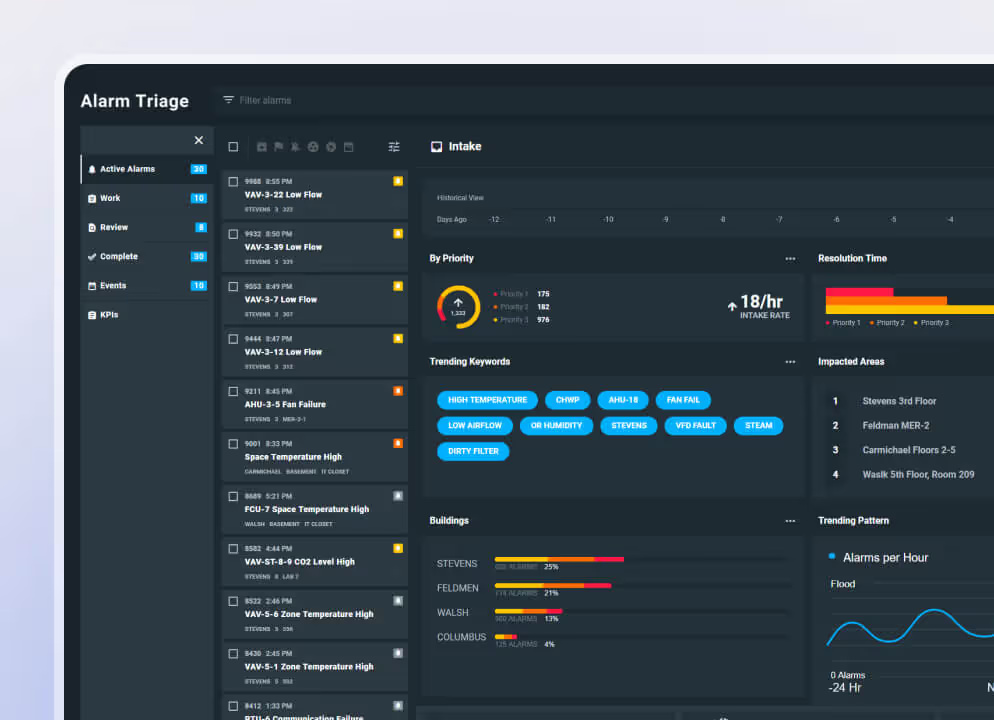
  • Virtual Facility is an alarm monitoring solution that centralizes and prioritizes facility alerts. It works in conjunction with a CMMS or EAM platform to connect alarm data to maintenance workflows, reducing the gap between an early warning signal and a work order response.
  • ProCal and ProCalX provide calibration management for regulated environments where instrument accuracy and traceability are compliance requirements. These solutions integrate with CMMS and EAM platforms to bring calibration records into the broader maintenance and audit documentation structure.

Preventive maintenance programs succeed when the tools supporting them are configured to match the organization's actual asset base, compliance obligations, and operational structure. 

TMA Systems brings implementation experience across industries and organizational scales. That means the support doesn't stop at software deployment. From data migration planning and system configuration to technician training and long-term program governance, the goal is a program that works in practice, holds up under scrutiny, and evolves as the organization's needs change.

Preventive maintenance programs succeed when the tools supporting them are configured to match the organization's actual asset base, compliance obligations, and operational structure. 

TMA Systems brings implementation experience across industries and organizational scales. That means the support doesn't stop at software deployment. From data migration planning and system configuration to technician training and long-term program governance, the goal is a program that works in practice, holds up under scrutiny, and evolves as the organization's needs change.

Ready to strengthen your preventive maintenance program?
Explore how TMA Systems' configurable platforms support execution, oversight, and long-term reliability.

FAQs about preventive maintenance programs

What is the difference between a preventive maintenance program and a preventive maintenance plan?

A preventive maintenance program is the overarching framework that defines how maintenance is structured, resourced, executed, and measured across the asset base.

A preventive maintenance plan is asset-specific. It outlines the tasks, frequency, and conditions for a particular piece of equipment. Multiple plans can operate under a single program that sets standards, governs data, and tracks performance.

Which industries require the most structured preventive maintenance programs?

Healthcare, manufacturing, utilities, and government facilities typically require the most structure.

Healthcare must meet strict biomedical and accreditation standards. Manufacturing depends on uptime for revenue. Utilities manage high-consequence infrastructure. Government facilities operate under public accountability and audit scrutiny. In each case, documentation and scheduling discipline are critical.

What role does CMMS or EAM software play in preventive maintenance?

CMMS software manages scheduling, work orders, parts, labor tracking, and maintenance documentation.

As asset counts grow, manual tracking creates gaps. EAM software extends visibility into lifecycle cost, capital planning, and cross-site performance. Together, these systems support consistent execution and reliable reporting.

How long does it take to implement a preventive maintenance program?

The timeline depends on organizational complexity and data quality.

A mid-market organization moving from spreadsheets to a CMMS may complete implementation in six to sixteen weeks if asset records are clean and ownership is defined early. Multi-site or regulated environments typically require more time. Data cleanup is the most common factor that extends implementation.

What are the most common mistakes in preventive maintenance program implementation?

Common mistakes include starting without a complete asset inventory, applying uniform maintenance frequency regardless of risk, and launching a system without technician training.

Programs also weaken when no one owns the data after go-live. Clear ownership, realistic scheduling, and structured rollout planning are essential.

How does TMA Systems support the execution of the preventive maintenance program?

TMA Systems provides configurable platforms for enterprise, mid-market, and healthcare environments.

WebTMA, MEX CMMS, and EQ2 HEMS support scheduling, work order management, asset tracking, and compliance documentation. Implementation guidance, data migration planning, and ongoing governance support help organizations build programs that perform operationally and withstand regulatory review.

Key Insights You'll Gain:
  • A preventive maintenance program governs strategy, planning, execution, and technology across your entire asset base.
  • Program design must reflect your industry's operational demands, compliance obligations, and asset complexity.
  • The right CMMS or EAM platform, implemented with clear governance, is what separates a program that scales from one that drifts.

Register for your free webinar

You’re all set!

Your webinar is on its way to your inbox. We hope it brings fresh insights and practical takeaways to help you get more from your maintenance operations.

Explore related resources

Resources
Blog
Preventive maintenance program guide for 2026
Resources
Blog
Preventive maintenance program guide for 2026
Resources
Blog
Preventive maintenance program guide for 2026
Blog
February 25, 2026
Preventive maintenance program guide for 2026
Blog
February 25, 2026
Preventive maintenance program guide for 2026
Blog
Preventive maintenance program guide for 2026
Blog
February 25, 2026
Preventive maintenance program guide for 2026
Blog
Preventive maintenance program guide for 2026
February 25, 2026
Blog
February 25, 2026
Preventive maintenance program guide for 2026

Industry
Corporate
Location
Size
Written by
Presenters
No items found.
Share

Running a solid preventive maintenance program has always taken discipline. In 2026, it takes more than that. Facilities teams are managing older infrastructure with leaner crews, facing tighter compliance scrutiny, and being asked to do more with budgets that haven't kept pace with operational demands. Reactive maintenance still happens, but organizations that rely on it as a default are paying for it in unplanned downtime, emergency labor costs, and equipment that wears out faster than it should.

A structured approach, supported by the right preventive maintenance software, gives teams the visibility and control to stay ahead of failures, manage costs predictably, and withstand audits.

What is a preventive maintenance program?

Preventive maintenance is scheduled, condition-based, or usage-triggered work performed on assets before they fail. A preventive maintenance program is the organizational framework that governs how that work gets planned, assigned, executed, documented, and measured across your entire asset base. It spans people, processes, and technology and operates at a level above individual work orders or maintenance schedules.

The table below clarifies how the term sits alongside concepts that are often used interchangeably.

Concept Definition How It Differs
Preventive maintenance program The organizational framework governing how preventive maintenance is planned, executed, tracked, and improved across an asset base. Operates at the organizational level and encompasses strategy, tools, and accountability structures.
Preventive maintenance plan A documented schedule of specific maintenance tasks for a defined asset or asset group. Tactical and asset-specific; one component within the broader program.
Preventive maintenance strategy The decision framework for how an organization prioritizes and approaches asset care, including risk tolerance and resource allocation. Informs the program’s design and guides decisions about frequency, method, and priority.
Preventive maintenance checklist A standardized task list used to execute and document a specific maintenance activity. An operational tool used at the point of execution, not a program management document.
Preventive maintenance software Technology purpose-built to schedule, automate, and track preventive maintenance tasks, asset records, and compliance documentation. Differs from general CMMS in its focus on PM-specific workflows and functions as the execution layer within a broader program.
CMMS software A computerized maintenance management system used to schedule, track, and report on maintenance work and assets. Technology that supports program execution but does not replace the governance structure around it.
Reactive maintenance Unplanned repair work performed after an asset has already failed or degraded. The default without a structured program; higher cost and lower predictability than reactive vs. preventive maintenance approaches.

Organizations with mature programs use enterprise asset management software to connect asset data, maintenance history, cost tracking, and compliance documentation in a single system. That integration matters because a program that exists only in spreadsheets or the minds of experienced technicians is fragile. When those technicians leave, or an auditor requests records, the gaps become costly problems.

A preventive maintenance program governs the full picture: the strategy behind the decisions, the plans that carry them out, the tools that support execution, and the data that proves it's working. The checklist below captures what that program needs to cover in practice.

Preventive maintenance checklist: what every program should include

A preventive maintenance checklist translates program intent into repeatable, auditable action. Where the program sets direction, the checklist operationalizes it at the task level. Maintenance managers use checklists to standardize execution across technicians, shifts, and sites so that work gets done the same way every time, regardless of who's doing it.

Every well-run preventive maintenance program should account for the following:

  • Asset inventory completeness: All maintainable assets are identified, documented, and assigned unique records. Equipment without a record cannot be scheduled, tracked, or protected from equipment failure.
  • Risk ranking methodology: Assets are prioritized based on operational criticality, safety exposure, and failure consequence. High-criticality assets receive tighter scheduling tolerances and closer monitoring to reduce the risk of equipment failure that disrupts operations.
  • Task standardization: Maintenance services are defined in written procedures and applied consistently across time-based maintenance and usage-based maintenance models.
  • Scheduling logic: Maintenance triggers are defined using calendar intervals, runtime hours, meter readings, or condition indicators. A preventive maintenance schedule should reflect actual asset demand, supported by real-time data where available, rather than default intervals carried forward without review.
  • Parts and labor allocation: Required parts and labor hours are identified at the work order level before the job is placed on the maintenance calendar. Technicians arrive prepared, reducing delays and limiting the likelihood of secondary equipment failure caused by incomplete work.
  • Documentation standards: Technicians record findings, corrective actions, and parts usage. Reliable records extend asset lifespan and help identify patterns that may justify a shift toward predictive maintenance.
  • Audit tracking: Inspection and compliance records are stored in a retrievable format with timestamps and technician attribution. This protects the organization during audits and validates that preventive maintenance services are performed as scheduled.
  • Reporting cadence: Program performance is reviewed on a defined schedule. Metrics such as PM compliance rate, mean time between failures, and backlog volume help maintenance leaders adjust the preventive maintenance schedule before minor issues escalate into costly repairs.
  • CMMS governance: The maintenance system has a defined owner and clear data standards. Governance keeps real-time data accurate and supports long-term reliability analysis.

A preventive maintenance checklist operationalizes the broader preventive maintenance program. It provides a structured way to align preventive maintenance schedules, maintenance services, and documentation so assets operate reliably and consistently. The next section examines how those requirements shift by industry, because operational context shapes how each element is prioritized.

Preventive maintenance requirements by industry

Program design varies by industry, and those differences are operational, not cosmetic. The compliance obligations, asset profiles, and failure consequences vary enough across industries that a program structure that works in one environment can leave serious gaps in another. A program built without that context tends to miss the riskiest areas.

The table below outlines how preventive maintenance requirements shift by industry, and what that means for program structure and execution.

Industry Specific Operational Needs Preventive Maintenance Program Implications
Healthcare Regulatory compliance, patient safety, equipment validation, biomedical asset oversight Detailed documentation standards, calibration tracking, audit-ready records, strict scheduling controls tied to clinical and accreditation requirements
Education Aging building stock, seasonal occupancy shifts, deferred maintenance backlogs, life safety system compliance Scheduled inspections aligned to academic calendars, life safety tracking, capital planning support for aging infrastructure, work order visibility across distributed campuses
Manufacturing Equipment uptime, production line dependencies, parts availability, safety inspection requirements Asset hierarchy structured by process and equipment class, integrated inventory control, pre-start and safety inspection workflows, scheduling tied to production demand
Commercial Real Estate Tenant satisfaction, multi-building portfolios, lease compliance, energy performance Portfolio-level reporting, space and equipment tracking across properties, vendor coordination, maintenance cost visibility by asset and location
Utilities & Energy Critical infrastructure reliability, regulatory reporting, remote asset management, safety compliance Rigorous PM scheduling for high-consequence assets, compliance documentation, mobile and offline work execution for field technicians, long asset lifecycle tracking
Government & Public Sector Public accountability, budget constraints, security requirements, multi-site facility management Standardized workflows across facilities, audit-ready records, capital planning support, compliance reporting aligned to federal and state requirements

Programs built around actual industry requirements consistently produce better data, fewer failures, and stronger audit outcomes. The next section walks through how to build that structure from the ground up.

How to create a preventive maintenance program

Knowing what a preventive maintenance program should cover is straightforward on paper. Operationalizing it under daily pressure, competing priorities, and limited resources is where most programs stall. The five steps below provide a practical framework for moving from intent to execution, whether you're formalizing a program for the first time or rebuilding one that has drifted.

1. Define objectives and success metrics 

Before scheduling a single work order, clarify what the program is supposed to accomplish. Reduced unexpected downtime, improved PM completion rates, lower maintenance costs per asset, and stronger audit readiness are all measurable outcomes. They give the program direction and give leadership a way to evaluate whether it's working. Without defined metrics, programs stay busy but don't become more effective. Set a baseline, identify targets, and agree on how performance will be reviewed and who will be responsible for acting on it.

2. Assess assets and prioritize by risk 

Not every asset warrants the same maintenance frequency or attention. A structured asset assessment identifies what you're maintaining, where each asset sits in the operational hierarchy, and what failure actually costs in terms of safety exposure, production impact, compliance risk, and repair spend. High-criticality assets get tighter schedules and more rigorous documentation requirements. Lower-risk assets can run for longer periods without significant operational consequences. Prioritization keeps a program focused on what matters rather than spreading thin across everything equally.

3. Standardize procedures and schedules 

Inconsistent execution is one of the most common reasons preventive maintenance programs produce unreliable data. When technicians perform the same task differently depending on shift, site, or experience level, the records are hard to compare and harder to act on. Standardized procedures define what gets done, in what sequence, and what gets documented. Schedules should reflect actual asset demand, whether calendar-based, runtime-triggered, or condition-driven, rather than arbitrary intervals inherited from a previous system.

4. Establish accountability and reporting 

A preventive maintenance program without clear ownership erodes quietly. Define who maintains the asset library, who reviews PM completion rates, and who is responsible for acting when the backlog grows or repeat failures appear on the same asset. That role clarity keeps the program from becoming everyone's responsibility in theory and no one's in practice. Regular reviews of key metrics matter equally, keeping the program visible to leadership and giving maintenance managers the information they need to adjust priorities before deferred work compounds into more expensive work.

5. Use CMMS/EAM software to scale and sustain

Manual processes can support a small program across a limited asset base, but they don't hold up as asset counts grow, sites multiply, or compliance requirements tighten. At that point, the administrative burden of running a preventive maintenance program without software becomes a real liability.

Reviewing the best CMMS software options helps maintenance leaders understand what structured execution looks like at scale, with automated scheduling, mobile work order access, inventory integration, and audit-ready documentation built into daily workflows. For organizations managing complex asset portfolios or multiple facilities, evaluating the best enterprise asset management software adds asset lifecycle visibility, capital planning support, and cross-site reporting to the program's foundation.

Integration matters here, too. A CMMS that connects to ERP systems, purchasing workflows, inventory platforms, and alarm feeds gives maintenance teams far more operational control than one that operates in isolation. Parts availability, purchase order status, and equipment alerts are all visible within the same system that manages work orders, reducing manual coordination that can create gaps in program execution.

Data migration should also be explicitly planned. Moving asset records, maintenance histories, and open work orders from a legacy system or spreadsheet environment into a new platform introduces risk if it's treated as an afterthought. Incomplete or miscategorized historical data undermines the reporting and reliability analysis on which the program depends from day one.

Getting implementation right from the start protects the program's long-term performance. The next section covers where programs commonly break down, which is just as important to understand as how to build them.

Ready to operationalize your preventive maintenance framework?
Speak with our team to align objectives, risk prioritization, and system strategy to your organization’s needs.

Common preventive maintenance program failures

Most preventive maintenance programs don’t break down due to a lack of intent. They weaken when structural issues accumulate and disconnect the preventive maintenance schedule from daily execution. A system launch without proper rollout planning, unclear ownership, or weak training can undermine a program before it stabilizes. Recognizing these patterns early protects asset lifespan and limits exposure to costly repairs.

  • Incomplete asset inventory: A program can only manage what exists in the system. Missing or outdated records distort the preventive maintenance schedule, leaving assets exposed to equipment failure. When inventory data is unreliable, maintenance services become reactive instead of planned.
  • Overloaded scheduling: Setting the maximum frequency for every asset creates an unrealistic maintenance calendar. When technicians can’t complete assigned work, compliance rates fall, and the preventive maintenance schedule loses credibility. Intervals should reflect risk and capacity, whether using time-based maintenance, usage-based maintenance, or a combination of both.
  • Technician resistance: Slow systems, unclear workflows, or excessive data entry requirements drive workarounds. Paper notes and skipped fields reduce the quality of real-time data and make predictive maintenance difficult to support.
  • Underestimating change management: Moving from reactive work to a structured preventive maintenance schedule requires clarity and follow-through. Technicians and supervisors must understand how their documentation supports asset lifespan and reduces equipment failure. Without that understanding, adoption fades over time.
  • Poor data governance: Asset records drift when no one maintains them. Over time, unreliable data weakens reporting, hides early warning signs, and limits the ability to use real-time data to prevent costly repairs.
  • Lack of executive oversight: When leadership stops reviewing preventive maintenance metrics, staffing, and budget decisions shift toward reactive priorities. Reduced oversight cuts into equipment longevity and increases the likelihood of equipment failure during peak demand.
  • No integration between alarms, calibration, and CMMS: When alarm feeds, calibration systems, and work orders operate separately, early warning signals remain isolated. Real-time data that could prevent equipment failure goes unused. This fragmentation undermines predictive maintenance efforts and increases the risk of costly repairs.

Preventive maintenance programs rarely fail in a single event. They decline through small disconnects between schedule, execution, and oversight. Addressing these gaps early keeps assets running smoothly and protects long-term performance.

How to measure preventive maintenance program effectiveness

A preventive maintenance program can look productive on the surface while losing ground operationally. Schedules are followed, work orders get closed, and the dashboard looks fine, yet unplanned failures keep happening, and costs keep rising. The KPI (key performance indicator) metrics below give maintenance managers and executives a clearer view of what's actually working. They’re also the same metrics that credible CMMS software should consistently surface in its reporting.

Metric What It Indicates Why Leadership Cares
PM compliance rate Percentage of scheduled preventive maintenance tasks completed on time Low compliance signals scheduling problems, labor gaps, or technician adoption issues before they become failures
Unplanned downtime % Share of total downtime attributed to unplanned failures Directly tied to production loss, emergency labor costs, and operational risk exposure
Mean time between failure (MTBF) Average operating time between asset failures Rising MTBF indicates the program is extending asset reliability; declining MTBF warrants review of maintenance frequency and procedures
Maintenance cost per asset Total maintenance spend divided across the asset base Identifies high-cost assets that may require replacement, procedure adjustment, or deeper reliability analysis
Work order backlog trend Volume of open, overdue, or deferred work orders over time A growing backlog indicates the program is generating more demand than the team can execute, increasing failure risk
Asset lifecycle cost trend Cumulative maintenance, repair, and operational costs tracked over an asset's life Supports capital planning decisions and helps determine when repair costs justify replacement
Audit findings Number and severity of compliance gaps identified during internal or external audits Reflects documentation quality, scheduling discipline, and reliability of maintenance records under scrutiny

These metrics depend on the quality of the data behind them. CMMS reporting surfaces accurate numbers when asset records are complete, work orders are closed with full documentation, and technicians are entering data in the system rather than working around it. Data governance and technician adoption shape what leadership sees when they open a report and whether those numbers are worth acting on. Organizations that review operational metrics monthly and lifecycle or cost trends quarterly build the kind of visibility that turns program adjustments from reactive responses into deliberate decisions.

How TMA Systems supports structured preventive maintenance

A well-designed preventive maintenance program still needs the right platform behind it. TMA Systems offers a portfolio of configurable solutions for organizations at different levels of complexity, from mid-market industrial operations to large multi-site enterprises with formal compliance and governance requirements.

  • WebTMA is TMA's enterprise CMMS and asset management platform, built for complex, multi-site organizations that require structured preventive maintenance scheduling, asset lifecycle tracking, compliance documentation, and centralized reporting. It supports facilities teams managing large asset portfolios where governance, audit readiness, and capital planning are operational priorities alongside day-to-day maintenance execution. WebTMA also supports integration with ERP, purchasing, and inventory systems, keeping maintenance data connected to the financial and operational systems that leadership depends on.
  • MEX CMMS is designed for mid-market organizations managing equipment-centric asset bases where technician adoption and execution speed directly affect program outcomes. It delivers structured preventive maintenance workflows, integrated parts and inventory control, and mobile offline capability for teams working in plants, yards, or field environments where connectivity isn't reliable.
  • EQ2 HEMS is a purpose-built CMMS for healthcare environments where hospital or biomedical equipment maintenance, calibration tracking, and regulatory compliance documentation carry direct patient safety implications. It supports hospital facilities teams in maintaining audit-ready records and scheduling controls aligned to clinical accreditation requirements.
  • Virtual Facility is an alarm monitoring solution that centralizes and prioritizes facility alerts. It works in conjunction with a CMMS or EAM platform to connect alarm data to maintenance workflows, reducing the gap between an early warning signal and a work order response.
  • ProCal and ProCalX provide calibration management for regulated environments where instrument accuracy and traceability are compliance requirements. These solutions integrate with CMMS and EAM platforms to bring calibration records into the broader maintenance and audit documentation structure.

Preventive maintenance programs succeed when the tools supporting them are configured to match the organization's actual asset base, compliance obligations, and operational structure. 

TMA Systems brings implementation experience across industries and organizational scales. That means the support doesn't stop at software deployment. From data migration planning and system configuration to technician training and long-term program governance, the goal is a program that works in practice, holds up under scrutiny, and evolves as the organization's needs change.

Preventive maintenance programs succeed when the tools supporting them are configured to match the organization's actual asset base, compliance obligations, and operational structure. 

TMA Systems brings implementation experience across industries and organizational scales. That means the support doesn't stop at software deployment. From data migration planning and system configuration to technician training and long-term program governance, the goal is a program that works in practice, holds up under scrutiny, and evolves as the organization's needs change.

Ready to strengthen your preventive maintenance program?
Explore how TMA Systems' configurable platforms support execution, oversight, and long-term reliability.

FAQs about preventive maintenance programs

What is the difference between a preventive maintenance program and a preventive maintenance plan?

A preventive maintenance program is the overarching framework that defines how maintenance is structured, resourced, executed, and measured across the asset base.

A preventive maintenance plan is asset-specific. It outlines the tasks, frequency, and conditions for a particular piece of equipment. Multiple plans can operate under a single program that sets standards, governs data, and tracks performance.

Which industries require the most structured preventive maintenance programs?

Healthcare, manufacturing, utilities, and government facilities typically require the most structure.

Healthcare must meet strict biomedical and accreditation standards. Manufacturing depends on uptime for revenue. Utilities manage high-consequence infrastructure. Government facilities operate under public accountability and audit scrutiny. In each case, documentation and scheduling discipline are critical.

What role does CMMS or EAM software play in preventive maintenance?

CMMS software manages scheduling, work orders, parts, labor tracking, and maintenance documentation.

As asset counts grow, manual tracking creates gaps. EAM software extends visibility into lifecycle cost, capital planning, and cross-site performance. Together, these systems support consistent execution and reliable reporting.

How long does it take to implement a preventive maintenance program?

The timeline depends on organizational complexity and data quality.

A mid-market organization moving from spreadsheets to a CMMS may complete implementation in six to sixteen weeks if asset records are clean and ownership is defined early. Multi-site or regulated environments typically require more time. Data cleanup is the most common factor that extends implementation.

What are the most common mistakes in preventive maintenance program implementation?

Common mistakes include starting without a complete asset inventory, applying uniform maintenance frequency regardless of risk, and launching a system without technician training.

Programs also weaken when no one owns the data after go-live. Clear ownership, realistic scheduling, and structured rollout planning are essential.

How does TMA Systems support the execution of the preventive maintenance program?

TMA Systems provides configurable platforms for enterprise, mid-market, and healthcare environments.

WebTMA, MEX CMMS, and EQ2 HEMS support scheduling, work order management, asset tracking, and compliance documentation. Implementation guidance, data migration planning, and ongoing governance support help organizations build programs that perform operationally and withstand regulatory review.

You’ve seen what’s possible—connect with us to learn how TMA Systems can support your goals beyond the event.

You’ve read the insights, now see how TMA Systems helps teams put them into practice.

From ideas to impact

You’ve read the insights, now see how TMA Systems helps teams put them into practice.

From screen to solution

You’ve watched what’s possible, now see how TMA Systems works for your organization.

From results to reality

You’ve seen the success, now discover how TMA Systems can deliver it for your team.

From insight to implementation

You’ve explored the strategies, now see how we can bring them to life across your real facilities.

From insight to implementation

You’ve explored the strategies, now see how we can bring them to life across your real facilities.

Preventive Maintenance