
Why food & beverage manufacturers need more than basic CMMS software
In this post
%20(1).avif)
.avif)
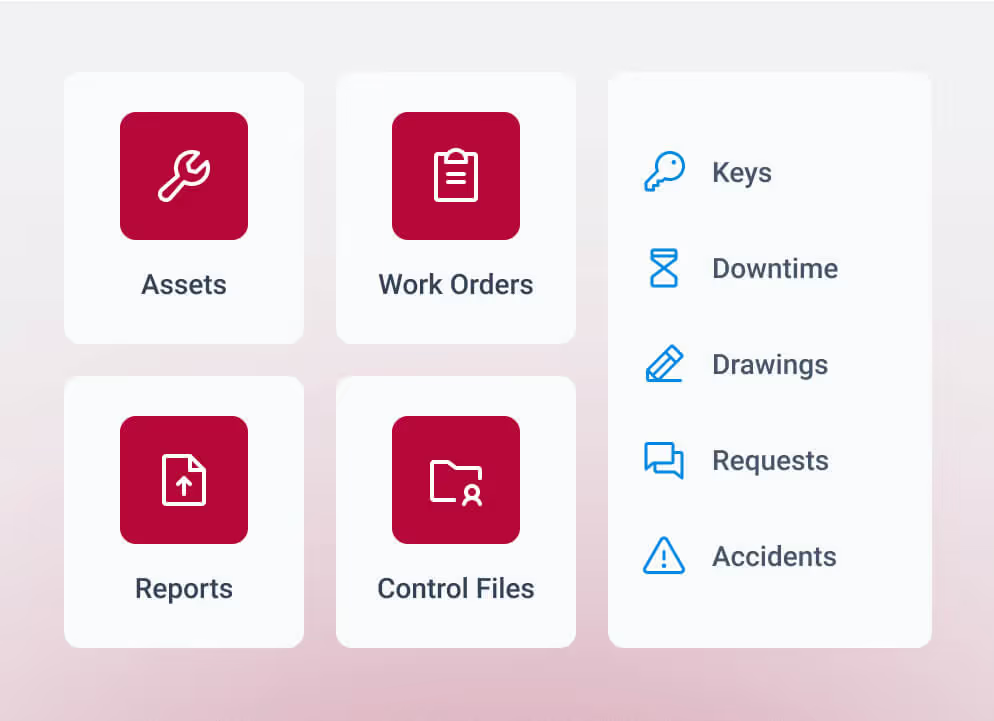

Food and beverage manufacturers may run on spreadsheets or a basic work order system and maintenance starts simple. Once production lines, inspections, spare parts, PM schedules, and compliance records start depending on each other, independent tools get harder to trust. You need CMMS software because the stakes get higher and higher.
For example, a part that's out of stock leaves packaging equipment idle while someone hunts one down. Thin inspection records make audits harder than they need to be. Patchy equipment history makes it harder to see why the same asset keeps failing too. Once that happens, the team needs CMMS software for the food and beverage industry.
Common maintenance challenges in Food & Beverage manufacturing
Maintenance problems in food and beverage come down to uptime, record keeping, and visibility. Here are some pressing issues that can be solved by a CMMS software for manufacturing.
Critical lines go down with no clear history
When critical equipment goes down, the team is counting on having access to certain information. A closed work order alone doesn’t tell a technician what failed last time or if the issue keeps coming back. Without that history, every breakdown takes longer to understand.
Preventive maintenance fails
Preventive maintenance only works if teams can quickly see what needs to be done. If the team relies on someone remembering to check a spreadsheet, PMs are easier to miss. This pushes the team back into emergency repairs. That leads to higher maintenance costs and more downtime.
Missing parts slow down repairs
A ten-minute repair stretches into a day when the part isn't on the shelf. With inventory outside the work order system, supervisors schedule jobs without knowing what's in stock, and purchasing doesn't see low levels until it's urgent.
Compliance records are hard to trust
Food safety and regulatory compliance depend on records the team can stand behind. That gets harder when inspection notes, sanitation details, corrective actions, and equipment history live in different places. Audit prep turns into a search project.
Limited visibility into equipment performance
Leaders need to know which assets fail most, which repairs eat the most time, and which lines generate the most work. Without consistent failure codes, repair history, and labor hours, those answers are tough to get.
Why spreadsheets and lightweight CMMS solutions fall short
Spreadsheets can track a simple list. They can't manage work orders, asset hierarchies, spare parts, compliance records, and PM scheduling as one connected system. That's where the gaps turn into cost.
Work stays manual: Schedules, reminders, and data entry require someone remembering what’s next. As the operation grows, manual tracking is the first thing to break.
Data sits in silos: inventory is in one sheet, and inspections are somewhere else. No one view shows if a job can even start and every task being done isn’t as efficient as it could be.
Reporting is thin: Pulling downtime, backlog, or PM completion means cleaning up data constantly and opening the organization up to compliance risk.
Inventory is disconnected from the work: When spare parts aren’t in the system, repairs stall while waiting on parts. So teams get stuck in a cycle of reactive vs preventative maintenance.
Asset health is invisible. Without repair history tied to each asset, teams end up in more urgent situations that take up valuable time and money.
The result is reactive maintenance, compliance risk, and higher operating costs. These are the exact things a food and beverage operation can least afford.
What to look for in a modern CMMS
A basic CMMS helps teams track maintenance work. A modern CMMS gives the team a fuller picture of the work around it: what’s due, what’s late, which asset is involved, what parts are available, and what records need to be kept.
That difference matters in food and beverage operations. The best CMMS solutions move teams from reactive maintenance to proactive asset management, with the uptime, compliance, and visibility that food and beverage operations need to be successful. The difference shows up in capabilities like preventive maintenance, CMMS compliance, and others highlighted in the table below.
The right CMMS should make daily maintenance easier to run, from assigning work to getting technicians to update records consistently. That same system should also give leaders better data on compliance readiness, asset performance, and where maintenance needs to improve.

What is the best CMMS for food and beverage manufacturers?
The best CMMS depends on your maintenance complexity, compliance requirements, asset portfolio, and growth plans. For example, a single beverage plant and a multi-site manufacturer may need to consider different options like cloud-based vs on-premise CMMS.
What the best CMMS software for manufacturing will offer is consistent. It should be easy for technicians to use and strong enough to support compliance records. It also needs to be flexible enough to handle parts, reporting, mobile work, and growth.
How to choose the right CMMS
Start with the problems that slow the team down now. If technicians can’t find repair histories, prioritize asset tracking. If audit prep takes too long, compliance documentation and record retention need a closer look. Use the buying process to test how the system handles real work, not ideal workflows.
Once you know what you need to focus on, you can think through how to manage capability rollout. This critical part of the process makes all the difference, because technician adoption, compliance support, inventory management, scalability, and reporting all impact on long-term CMMS success.
Use the buying process to test how the system handles workflows.
How MEX helps maintenance teams improve visibility and execution
MEX pulls the daily work into one system and is built around the way food and beverage teams operate. Users get features like technician-first workflows, integrated inventory, mobile and offline access, embedded inspections, and asset lifecycle visibility.
Work orders and PM scheduling: Supervisors see what's open and overdue. Technicians get the asset's job history before they start. PMs schedule by time or usage, so service is planned around the asset.
Asset history and parts: Equipment records, repair history, documents, and parts usage sit with the asset. Since a missing part can keep a line down longer than the repair itself, MEX keeps stock levels and usage visible.
Mobile, offline, and inspections: MEX Mobile reaches assets, work orders, and inventory in the field with no connection, then syncs when it returns. Prestart checklists capture readings, attach photos, and raise a maintenance request when a check fails.
Reporting: Costs, asset performance, backlog, and downtime come out of the system to increase accuracy and save time.
MEX gives food and beverage maintenance teams a better way to manage work. With the right information easier to find and update, teams spend less time chasing details and more time keeping production moving. You can explore more about the MEX product and request a personalized demo here.
The next step in maintenance maturity
As food and beverage plants grow, maintenance affects production schedules, audit readiness, and where time and money go. That’s when spreadsheets and basic CMMS tools stop being enough. The right CMMS improves maintenance execution, gives leaders the data to make informed decisions. It also builds a foundation that improves performance and speeds up growth.
FAQs about CMMS software for food & beverage industry
Related resources
From ideas to impact
You’ve read the insights, now see how TMA Systems helps teams put them into practice.