



Situation Awareness and Control Room Alarm Monitoring Software
In this post
%20(1).avif)
1
2
3
Facility teams drown in alarms, sensors, and shrinking expertise. Learn how situation awareness transforms raw building data into context-rich, prioritized insights so operators can see critical issues faster, make better decisions, and prevent costly failures.
“Situation Awareness” — Coming Soon to a Facility Management Control Room Near You
Situation Awareness drives better decision-making by turning data into actionable Information and focusing attention on critical alarms & events.
Providing systems that support situation awareness (SA) is a commonly used technique to improve operator decision-making in mission critical applications like aviation, power generation, transportation, nuclear, medicine, and oil & gas. Notice that I didn’t mention facility management (FM) of data centers, or institutions like healthcare and higher education. Somehow FM has managed to resist the compelling benefits of SA.
This is the first in a series of articles that will discuss the what, why, where, and how of situation awareness as applied to facilities management. Spoiler Alert! SA answers the following:
“Are there any critical issues within my facility that I need to know about - so I can evaluate impact and coordinate labor response?”
SA supports better decision-making — something we can all use.
Situation Awareness — The Why Part I (Mind the Gap)
Facility management teams are in a constant state of data overload from unstructured and unprioritized data. The amount of the data they must sort through and make sense of is overwhelming. It is not uncommon for them to be responsible for understanding the meaning behind over 100K points (sensors) and 10K alarms. It is estimated that 100K points can create 2.5B measurements in a 24-hour span. And its only getting worse…The amount of building data generated by the various systems they manage (BAS, life safety, medical gas, elevators) is constantly on the increase thanks to new equipment, facility expansion, and IoT devices.
On top of the data overload, facility management teams are confronted with the loss of experienced people (retirement, the great resignation, skilled labor shortage) and a struggle to replace the knowledge and experience that has been lost. It takes years of training and experience to come up to speed. This creates a gap between the amount of data to be processed / understood and the ability to comprehend / act upon it.

Figure 1. Gap Between Facility Data and FM Collective Skill Level
A focus on situation awareness in facility management can close this gap.
Situation Awareness — The What
If you google “Situation Awareness” or “Situational Awareness” you will find several definitions, many of which can be kind of abstract and theoretical. So here is a definition for situation awareness as applied to facilities management:
Situation Awareness for FM: “being able to distill building data into what is most important (critical) at a specific time to a specific role, presenting it in a meaningful way (adding context) that helps the operator understand what has happened, envision future consequences, and decide the best course of action.”
Still a mouthful. Let’s take a look at a picture.
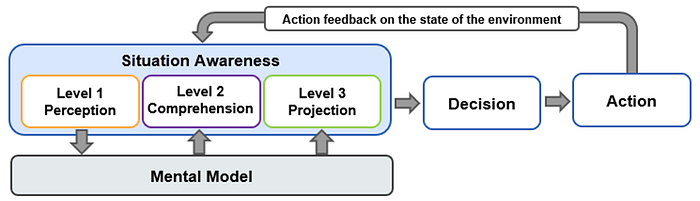
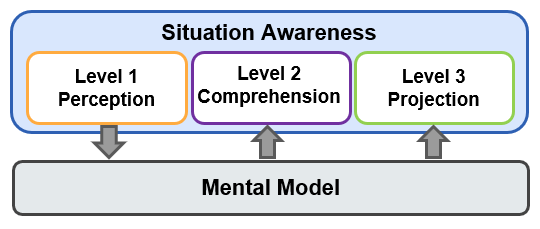
Figure 2. Situation Awareness as Adapted from Endsley, M. R. (1995). Toward a theory of situation awareness in dynamic systems. Human Factors: The Journal of the Human Factors and Ergonomics Society, 37(1), 32–64.
Situation awareness is characterized by three levels (perception, comprehension, and projection) each of which relates to the operator’s cognitive processing and their mental model of the system / facility. Each level answers a different set of questions (as shown in Table 1 below) propelling the person toward an (informed) decision and appropriate action. The output of SA is a decision and an action; this is why we say that the purpose of SA is to drive more-effective decision-making.

Table 1. Elements of Situation Awareness
Let’s see how it all fits together. A mechanic is dispatched to investigate a chiller compressor high vibration alarm. The mechanic listens to the compressor while it is running, looks at the local gauges on the machine, and detects an odor of burning rubber (Perception). He applies his mental model of how the compressor should sound, feel, and behave to diagnose the situation and determine that the compressor belt should be replaced (Comprehension). Since this chiller feeds conditioned air to several critical spaces (hospital operating rooms), the mechanic extrapolates that an outright failure of the compressor could impact the scheduling of surgery (Projection). Thanks to situation awareness, he is able to (hopefully) address the situation before it escalates into a significant problem.
Situation Awareness — Before
Glancing at the PC display, the operator notices what appears to be a new alarm on the BAS alarm list in the midst of a bunch of stale alarms:
- “SA Fan Failure on AHU 97-A” (Priority = 50)
What if this was all the data that the operator received? With this minimal set of information it is hard to comprehend the alarm’s importance, what it means, project future impact, or determine what action should be taken. If the operator had been subjected to a bunch of nuisance alarms recently, then they might ignore this alarm. With this delivery of information it is no wonder that “operator error” is cited as a causal factor in 60–85% of accidents [Endsley 2012]. But is it really “operator error” if a change to the way information is delivered to the operator can reduce the likelihood of a mistake? This sounds more like “Technology-Centered Design” error — a topic for another day.
Situation Awareness — After
With a focus on improving awareness and decision-making, the following information is provided to the operator as part of situation awareness displays:
- “SA Fan Failure on AHU 97-A” (Priority = Critical)
- “The equipment associated with this alarm is located in the 3rd floor mechanical room in the Brown building.” (Perception)
- “AHU-97A is upstream of and connects to VAV’s 102–105, which service the 3rd floor operating rooms in the Brown building (OR 3–1, 3–2, 3–3, and 3–4)” (Comprehension)
- “A SA fan failure is likely to impact the temperature, humidity, and pressure differential for the OR’s. If not addressed quickly this could develop into a non-compliance reportable event and surgeries might need to be rescheduled / patients relocated to another hospital.” (Projection)
Which scenario is more likely to lead to a successful outcome (Before or After)? An experienced operator might be able to fill in the missing context based on their mental model, but a new or non-technical operator will not. The nontechnical operator could dispatch to the wrong person / shop, delay the response, assign the wrong priority…
Key Benefits of Situation Awareness
- Turns data into actionable information — By displaying data in context it helps operators process more data and understand what the data is telling them.
- Drives better decision-making — Operators are not just reacting to piecemeal data out of context, but instead are able to understand what it means and envision how it could impact facility operation.
- Delivers the “big picture” and surfaces critical events and situations — Systematically filters, prioritizes and aggregates data to summarize and present what is important.
- “Levels up” your FM team — By capturing the institutional knowledge of your senior personnel and integrating it into SA displays to build / reinforce the operator’s mental model of the facility.
Situation Awareness — The Why Part II (A world without SA)
Situation awareness helps us gain a greater awareness of what is going on around us in the facility and helps us understand what this means now and in the future. It helps us make better decisions and to take appropriate actions.
So what can happen in a world without situation awareness? We are much more likely to miss or ignore a critical alarm / event, address a situation incorrectly, fail to respond in a timely manner, or respond to a situation in a temporary fashion — failing to address root cause. These failures can lead to consequences such as occupant / staff complaints, damage to equipment / assets, unplanned shutdowns, or personnel accidents; with varying degrees of business impact as shown in Figure 3 below.

Figure 3. Cause / Consequence / Business Impact of Missing Critical Alarms & Events
- Facility teams are drowning in data — 100,000 points and 10,000 alarms can generate 2.5 billion measurements in just 24 hours, far more than humans can interpret without help.
- “Operator error” is cited as a causal factor in 60–85% of accidents, often because operators get piecemeal, context-free alarms instead of clear, actionable information.
- Situation Awareness turns raw building data into clear priorities — helping operators see what’s happening, understand its impact, and act before issues cause outages, compliance breaches, or safety risks.

Download the eBook now
You’re all set!
Your eBook is on its way to your inbox. We hope it brings fresh insights and practical takeaways to help you get more from your maintenance operations.
Explore related resources
.avif)
.svg)
Facility teams drown in alarms, sensors, and shrinking expertise. Learn how situation awareness transforms raw building data into context-rich, prioritized insights so operators can see critical issues faster, make better decisions, and prevent costly failures.
“Situation Awareness” — Coming Soon to a Facility Management Control Room Near You
Situation Awareness drives better decision-making by turning data into actionable Information and focusing attention on critical alarms & events.
Providing systems that support situation awareness (SA) is a commonly used technique to improve operator decision-making in mission critical applications like aviation, power generation, transportation, nuclear, medicine, and oil & gas. Notice that I didn’t mention facility management (FM) of data centers, or institutions like healthcare and higher education. Somehow FM has managed to resist the compelling benefits of SA.
This is the first in a series of articles that will discuss the what, why, where, and how of situation awareness as applied to facilities management. Spoiler Alert! SA answers the following:
“Are there any critical issues within my facility that I need to know about - so I can evaluate impact and coordinate labor response?”
SA supports better decision-making — something we can all use.
Situation Awareness — The Why Part I (Mind the Gap)
Facility management teams are in a constant state of data overload from unstructured and unprioritized data. The amount of the data they must sort through and make sense of is overwhelming. It is not uncommon for them to be responsible for understanding the meaning behind over 100K points (sensors) and 10K alarms. It is estimated that 100K points can create 2.5B measurements in a 24-hour span. And its only getting worse…The amount of building data generated by the various systems they manage (BAS, life safety, medical gas, elevators) is constantly on the increase thanks to new equipment, facility expansion, and IoT devices.
On top of the data overload, facility management teams are confronted with the loss of experienced people (retirement, the great resignation, skilled labor shortage) and a struggle to replace the knowledge and experience that has been lost. It takes years of training and experience to come up to speed. This creates a gap between the amount of data to be processed / understood and the ability to comprehend / act upon it.
Figure 1. Gap Between Facility Data and FM Collective Skill Level
A focus on situation awareness in facility management can close this gap.
Situation Awareness — The What
If you google “Situation Awareness” or “Situational Awareness” you will find several definitions, many of which can be kind of abstract and theoretical. So here is a definition for situation awareness as applied to facilities management:
Situation Awareness for FM: “being able to distill building data into what is most important (critical) at a specific time to a specific role, presenting it in a meaningful way (adding context) that helps the operator understand what has happened, envision future consequences, and decide the best course of action.”
Still a mouthful. Let’s take a look at a picture.
Figure 2. Situation Awareness as Adapted from Endsley, M. R. (1995). Toward a theory of situation awareness in dynamic systems. Human Factors: The Journal of the Human Factors and Ergonomics Society, 37(1), 32–64.
Situation awareness is characterized by three levels (perception, comprehension, and projection) each of which relates to the operator’s cognitive processing and their mental model of the system / facility. Each level answers a different set of questions (as shown in Table 1 below) propelling the person toward an (informed) decision and appropriate action. The output of SA is a decision and an action; this is why we say that the purpose of SA is to drive more-effective decision-making.
Table 1. Elements of Situation Awareness
Let’s see how it all fits together. A mechanic is dispatched to investigate a chiller compressor high vibration alarm. The mechanic listens to the compressor while it is running, looks at the local gauges on the machine, and detects an odor of burning rubber (Perception). He applies his mental model of how the compressor should sound, feel, and behave to diagnose the situation and determine that the compressor belt should be replaced (Comprehension). Since this chiller feeds conditioned air to several critical spaces (hospital operating rooms), the mechanic extrapolates that an outright failure of the compressor could impact the scheduling of surgery (Projection). Thanks to situation awareness, he is able to (hopefully) address the situation before it escalates into a significant problem.
Situation Awareness — Before
Glancing at the PC display, the operator notices what appears to be a new alarm on the BAS alarm list in the midst of a bunch of stale alarms:
- “SA Fan Failure on AHU 97-A” (Priority = 50)
What if this was all the data that the operator received? With this minimal set of information it is hard to comprehend the alarm’s importance, what it means, project future impact, or determine what action should be taken. If the operator had been subjected to a bunch of nuisance alarms recently, then they might ignore this alarm. With this delivery of information it is no wonder that “operator error” is cited as a causal factor in 60–85% of accidents [Endsley 2012]. But is it really “operator error” if a change to the way information is delivered to the operator can reduce the likelihood of a mistake? This sounds more like “Technology-Centered Design” error — a topic for another day.
Situation Awareness — After
With a focus on improving awareness and decision-making, the following information is provided to the operator as part of situation awareness displays:
- “SA Fan Failure on AHU 97-A” (Priority = Critical)
- “The equipment associated with this alarm is located in the 3rd floor mechanical room in the Brown building.” (Perception)
- “AHU-97A is upstream of and connects to VAV’s 102–105, which service the 3rd floor operating rooms in the Brown building (OR 3–1, 3–2, 3–3, and 3–4)” (Comprehension)
- “A SA fan failure is likely to impact the temperature, humidity, and pressure differential for the OR’s. If not addressed quickly this could develop into a non-compliance reportable event and surgeries might need to be rescheduled / patients relocated to another hospital.” (Projection)
Which scenario is more likely to lead to a successful outcome (Before or After)? An experienced operator might be able to fill in the missing context based on their mental model, but a new or non-technical operator will not. The nontechnical operator could dispatch to the wrong person / shop, delay the response, assign the wrong priority…
Key Benefits of Situation Awareness
- Turns data into actionable information — By displaying data in context it helps operators process more data and understand what the data is telling them.
- Drives better decision-making — Operators are not just reacting to piecemeal data out of context, but instead are able to understand what it means and envision how it could impact facility operation.
- Delivers the “big picture” and surfaces critical events and situations — Systematically filters, prioritizes and aggregates data to summarize and present what is important.
- “Levels up” your FM team — By capturing the institutional knowledge of your senior personnel and integrating it into SA displays to build / reinforce the operator’s mental model of the facility.
Situation Awareness — The Why Part II (A world without SA)
Situation awareness helps us gain a greater awareness of what is going on around us in the facility and helps us understand what this means now and in the future. It helps us make better decisions and to take appropriate actions.
So what can happen in a world without situation awareness? We are much more likely to miss or ignore a critical alarm / event, address a situation incorrectly, fail to respond in a timely manner, or respond to a situation in a temporary fashion — failing to address root cause. These failures can lead to consequences such as occupant / staff complaints, damage to equipment / assets, unplanned shutdowns, or personnel accidents; with varying degrees of business impact as shown in Figure 3 below.
Figure 3. Cause / Consequence / Business Impact of Missing Critical Alarms & Events
- Facility teams are drowning in data — 100,000 points and 10,000 alarms can generate 2.5 billion measurements in just 24 hours, far more than humans can interpret without help.
- “Operator error” is cited as a causal factor in 60–85% of accidents, often because operators get piecemeal, context-free alarms instead of clear, actionable information.
- Situation Awareness turns raw building data into clear priorities — helping operators see what’s happening, understand its impact, and act before issues cause outages, compliance breaches, or safety risks.
Register for your free webinar
You’re all set!
Your webinar is on its way to your inbox. We hope it brings fresh insights and practical takeaways to help you get more from your maintenance operations.
Explore related resources
.svg)
.svg)

.avif)

“Situation Awareness” — Coming Soon to a Facility Management Control Room Near You
Situation Awareness drives better decision-making by turning data into actionable Information and focusing attention on critical alarms & events.
Providing systems that support situation awareness (SA) is a commonly used technique to improve operator decision-making in mission critical applications like aviation, power generation, transportation, nuclear, medicine, and oil & gas. Notice that I didn’t mention facility management (FM) of data centers, or institutions like healthcare and higher education. Somehow FM has managed to resist the compelling benefits of SA.
This is the first in a series of articles that will discuss the what, why, where, and how of situation awareness as applied to facilities management. Spoiler Alert! SA answers the following:
“Are there any critical issues within my facility that I need to know about - so I can evaluate impact and coordinate labor response?”
SA supports better decision-making — something we can all use.
Situation Awareness — The Why Part I (Mind the Gap)
Facility management teams are in a constant state of data overload from unstructured and unprioritized data. The amount of the data they must sort through and make sense of is overwhelming. It is not uncommon for them to be responsible for understanding the meaning behind over 100K points (sensors) and 10K alarms. It is estimated that 100K points can create 2.5B measurements in a 24-hour span. And its only getting worse…The amount of building data generated by the various systems they manage (BAS, life safety, medical gas, elevators) is constantly on the increase thanks to new equipment, facility expansion, and IoT devices.
On top of the data overload, facility management teams are confronted with the loss of experienced people (retirement, the great resignation, skilled labor shortage) and a struggle to replace the knowledge and experience that has been lost. It takes years of training and experience to come up to speed. This creates a gap between the amount of data to be processed / understood and the ability to comprehend / act upon it.
Figure 1. Gap Between Facility Data and FM Collective Skill Level
A focus on situation awareness in facility management can close this gap.
Situation Awareness — The What
If you google “Situation Awareness” or “Situational Awareness” you will find several definitions, many of which can be kind of abstract and theoretical. So here is a definition for situation awareness as applied to facilities management:
Situation Awareness for FM: “being able to distill building data into what is most important (critical) at a specific time to a specific role, presenting it in a meaningful way (adding context) that helps the operator understand what has happened, envision future consequences, and decide the best course of action.”
Still a mouthful. Let’s take a look at a picture.
Figure 2. Situation Awareness as Adapted from Endsley, M. R. (1995). Toward a theory of situation awareness in dynamic systems. Human Factors: The Journal of the Human Factors and Ergonomics Society, 37(1), 32–64.
Situation awareness is characterized by three levels (perception, comprehension, and projection) each of which relates to the operator’s cognitive processing and their mental model of the system / facility. Each level answers a different set of questions (as shown in Table 1 below) propelling the person toward an (informed) decision and appropriate action. The output of SA is a decision and an action; this is why we say that the purpose of SA is to drive more-effective decision-making.
Table 1. Elements of Situation Awareness
Let’s see how it all fits together. A mechanic is dispatched to investigate a chiller compressor high vibration alarm. The mechanic listens to the compressor while it is running, looks at the local gauges on the machine, and detects an odor of burning rubber (Perception). He applies his mental model of how the compressor should sound, feel, and behave to diagnose the situation and determine that the compressor belt should be replaced (Comprehension). Since this chiller feeds conditioned air to several critical spaces (hospital operating rooms), the mechanic extrapolates that an outright failure of the compressor could impact the scheduling of surgery (Projection). Thanks to situation awareness, he is able to (hopefully) address the situation before it escalates into a significant problem.
Situation Awareness — Before
Glancing at the PC display, the operator notices what appears to be a new alarm on the BAS alarm list in the midst of a bunch of stale alarms:
- “SA Fan Failure on AHU 97-A” (Priority = 50)
What if this was all the data that the operator received? With this minimal set of information it is hard to comprehend the alarm’s importance, what it means, project future impact, or determine what action should be taken. If the operator had been subjected to a bunch of nuisance alarms recently, then they might ignore this alarm. With this delivery of information it is no wonder that “operator error” is cited as a causal factor in 60–85% of accidents [Endsley 2012]. But is it really “operator error” if a change to the way information is delivered to the operator can reduce the likelihood of a mistake? This sounds more like “Technology-Centered Design” error — a topic for another day.
Situation Awareness — After
With a focus on improving awareness and decision-making, the following information is provided to the operator as part of situation awareness displays:
- “SA Fan Failure on AHU 97-A” (Priority = Critical)
- “The equipment associated with this alarm is located in the 3rd floor mechanical room in the Brown building.” (Perception)
- “AHU-97A is upstream of and connects to VAV’s 102–105, which service the 3rd floor operating rooms in the Brown building (OR 3–1, 3–2, 3–3, and 3–4)” (Comprehension)
- “A SA fan failure is likely to impact the temperature, humidity, and pressure differential for the OR’s. If not addressed quickly this could develop into a non-compliance reportable event and surgeries might need to be rescheduled / patients relocated to another hospital.” (Projection)
Which scenario is more likely to lead to a successful outcome (Before or After)? An experienced operator might be able to fill in the missing context based on their mental model, but a new or non-technical operator will not. The nontechnical operator could dispatch to the wrong person / shop, delay the response, assign the wrong priority…
Key Benefits of Situation Awareness
- Turns data into actionable information — By displaying data in context it helps operators process more data and understand what the data is telling them.
- Drives better decision-making — Operators are not just reacting to piecemeal data out of context, but instead are able to understand what it means and envision how it could impact facility operation.
- Delivers the “big picture” and surfaces critical events and situations — Systematically filters, prioritizes and aggregates data to summarize and present what is important.
- “Levels up” your FM team — By capturing the institutional knowledge of your senior personnel and integrating it into SA displays to build / reinforce the operator’s mental model of the facility.
Situation Awareness — The Why Part II (A world without SA)
Situation awareness helps us gain a greater awareness of what is going on around us in the facility and helps us understand what this means now and in the future. It helps us make better decisions and to take appropriate actions.
So what can happen in a world without situation awareness? We are much more likely to miss or ignore a critical alarm / event, address a situation incorrectly, fail to respond in a timely manner, or respond to a situation in a temporary fashion — failing to address root cause. These failures can lead to consequences such as occupant / staff complaints, damage to equipment / assets, unplanned shutdowns, or personnel accidents; with varying degrees of business impact as shown in Figure 3 below.
Figure 3. Cause / Consequence / Business Impact of Missing Critical Alarms & Events


Related resources
Related resources
You’ve seen what’s possible—connect with us to learn how TMA Systems can support your goals beyond the event.
You’ve read the insights, now see how TMA Systems helps teams put them into practice.


From ideas to impact
You’ve read the insights, now see how TMA Systems helps teams put them into practice.
From screen to solution
You’ve watched what’s possible, now see how TMA Systems works for your organization.
From results to reality
You’ve seen the success, now discover how TMA Systems can deliver it for your team.
From insight to implementation
You’ve explored the strategies, now see how we can bring them to life across your real facilities.
From insight to implementation
You’ve explored the strategies, now see how we can bring them to life across your real facilities.