
10 Best enterprise asset management software in 2026
In this post
%20(1).avif)
.avif)



As organizations grow, managing assets across multiple facilities, systems, and teams becomes increasingly complex. Maintenance leaders need to control costs and downtime while keeping accurate asset data, coordinating maintenance, and making informed decisions about when to maintain, repair, or replace equipment.
Enterprise Asset Management (EAM) software brings asset data, maintenance activities, performance, and costs into a centralized system, helping organizations manage assets throughout their lifecycle. Demand for these capabilities is growing: the global EAM market is projected to increase from $7.29 billion in 2026 to $16.42 billion by 2034, according to Fortune Business Insights.
Choosing the right EAM platform means finding a solution that fits your organization’s assets, workflows, integrations, industry requirements, and plans for growth. This guide compares 10 of the best EAM software platforms in 2026, including their key capabilities, ideal use cases, customer ratings, and other factors to consider when evaluating your options.
What is enterprise asset management software?
Enterprise asset management (EAM) software is a system for managing physical assets throughout their lifecycle, from acquisition and operation through maintenance, replacement, and retirement. It brings asset data, maintenance history, costs, condition, and other asset records into a centralized system, giving organizations greater asset visibility across facilities, equipment, and infrastructure.
EAM software connects day-to-day maintenance with broader asset and reliability management. Depending on the platform, organizations can use it to:
- Manage work orders, preventive maintenance, inspections, inventory, labor, and other maintenance workflows.
- Maintain an asset hierarchy and track asset location, condition, costs, history, and asset performance.
- Give maintenance teams access to work and asset information through mobile solutions.
- Use reporting and performance analysis to improve maintenance planning, reliability planning, and repair-or-replace decisions.
- Connect maintenance and asset information with other business systems through integrations and APIs.
- Maintain documentation and maintenance histories that support internal policies and regulatory requirements.
EAM is particularly useful for organizations with large or complex asset portfolios, multiple facilities, distributed maintenance teams, or a need to connect maintenance execution with longer-term maintenance strategies and capital planning.
EAM vs. CMMS: Which does your organization need?
EAM is one of several types of software used to manage maintenance, facilities, and physical assets. CMMS platforms, computerized maintenance management systems, are closely related but generally focus more specifically on maintenance operations.
CMMS platforms typically handle work management, work orders, preventive maintenance, scheduling, asset tracking, and other daily maintenance activities. EAM software expands that scope to cover the entire asset lifecycle, connecting maintenance with costs, condition, performance, reliability, and long-term planning.
For organizations primarily looking to organize and improve maintenance execution, CMMS platforms may provide the capabilities they need. EAM may be a better fit when operations involve complex asset portfolios, multiple locations, extensive integrations, advanced reporting, or connected maintenance workflows across departments.
The categories can overlap. Enterprise CMMS platforms may offer EAM capabilities, while organizations with broader facility and workplace needs may also consider CAFM or IWMS software. Rather than choosing based on the category alone, evaluate which platform provides the functionality, scalability, and support your organization needs today and as operations grow.
How we evaluated enterprise asset management solutions
Every organization has different requirements, so there’s no single EAM platform that’s best for everyone. To compare the options consistently, we considered product capabilities, scalability, usability, integrations, industry fit, and support, alongside customer ratings and reviews from Gartner Peer Insights, G2, and Capterra. We also drew on TMA Systems’ 30+ years of experience in maintenance and asset management to identify the factors that matter when evaluating enterprise solutions.
Evaluation criteria:
- Reliability: Proven system uptime and stable performance at enterprise scale.
- Scalability: Ability to expand across sites, departments, and asset classes without disrupting workflows.
- Ease of use: Design that supports quick adoption across technicians, managers, and administrators.
- Integration ecosystem: Compatibility with ERP, HR, accounting, and building management systems to unify data.
- Compliance readiness: Tools for audit tracking, documentation, and adherence to regulatory standards.
- Support and partnership: Quality of implementation, training, and long-term customer engagement.
- Return on investment: Measurable impact on cost control, uptime, and operational efficiency.
Each rating and review was sourced directly from Gartner Peer Insights™, reflecting verified feedback from users across industries including healthcare, education, manufacturing, and government.
Our evaluation reflects real-world priorities. With more than 30 years of experience working alongside facility managers, IT leaders, and operations teams, TMA Systems understands what drives performance in the field—reliability, configurability, and dependable support. The next generation of EAM platforms continues to advance through AI, IoT, and automation—enabling organizations to detect issues early, reduce downtime, and extend asset life through smarter insights and predictive maintenance.
10 best EAM software platforms in 2026
EAM platforms vary in capabilities, complexity, industry focus, and services, so the best choice depends on your organization’s assets, workflows, and requirements. Below, we compare 10 leading EAM software platforms based on their key features, best-fit use cases, customer ratings, and other factors to help you find the right solution.
1. WebTMA
TMA Systems has more than 30 years of experience developing maintenance and asset management software for complex organizations. WebTMA is its configurable EAM and CMMS platform for organizations that need to manage facilities, assets, and maintenance operations across multiple locations.
WebTMA is a configurable CMMS and EAM platform from TMA Systems, available as a cloud-based or on-premises solution. Built for organizations with complex facilities and asset portfolios, it helps teams centralize maintenance operations, asset data, and performance information across multiple locations.
WebTMA supports work orders, preventive maintenance, asset tracking, inspections, inventory management, reporting, mobile access, and capital planning. AI-assisted capabilities can help teams enrich asset data and streamline data entry, while integrations and APIs connect WebTMA with other enterprise and building systems. Its modular design allows organizations to configure and expand capabilities as their needs evolve. TMA Systems also brings more than 30 years of maintenance and asset management experience, with implementation, training, and ongoing support.
Best for: Education, healthcare, corporate, and other complex organizations that need a scalable, configurable CMMS/EAM platform for managing facilities and assets across multiple locations.
Gartner rating: 4.7/5
What users say: “The level of customer service provided by TMA far exceeds any other software vendor I have experience with. The product's functionality has enabled us to expand the software's use beyond its original intended use across multiple departments, leading to better integration.” — Business Manager, Finance

2. HEMS
HEMS is a healthcare-focused CMMS and EAM solution designed to help hospitals and health systems manage medical equipment, maintenance operations, service records, and asset performance across their organizations.
The platform supports asset tracking, preventive maintenance, work orders, equipment history, inspections, reporting, and documentation. Healthcare teams can use HEMS to improve equipment visibility, coordinate maintenance activities, and maintain the records and documentation needed to support regulatory, accreditation, and audit processes.
Best for: Hospitals and health systems that need a specialized asset and maintenance management platform built around the operational, documentation, and reporting requirements of healthcare environments.
3. IBM Maximo Application Suite
IBM Maximo combines asset management, IoT, and AI insights in a unified enterprise platform. It’s designed for organizations with complex operations and extensive asset networks. The suite supports performance monitoring, predictive maintenance, and compliance reporting at scale.
Best for: Large global enterprises managing high-value equipment and cross-departmental maintenance operations.
Gartner rating: 4.4/5
What users say: “I have been using IBM Maximo for nearly as long as I have been in the workforce. The flexibility that IBM Maximo offers allows my company to use a single software solution for multiple purposes. Before using IBM Maximo, these would have all been paper systems and much more cumbersome to manage.” — Nathaniel H., Process Engineer, Automotive
4. SAP EAM
SAP EAM extends the SAP S/4HANA suite to manage maintenance, reliability, and performance across global enterprises. It integrates maintenance workflows with core business systems to support compliance, cost management, and predictive analytics.
Best for: Large enterprises already using SAP infrastructure that need centralized asset management and compliance tracking.
Gartner rating: 4.3/5
What users say: “My overall experience with the tool is excellent. It provided all the tools we needed inside the company to make our transactions and plans go smoother and easier.” — Verified User
5. MaintainX
MaintainX is a mobile-first EAM and CMMS platform designed for fast adoption and field collaboration. Teams use it to manage work orders, document maintenance history, and collaborate in real time. Its intuitive interface helps technicians complete tasks efficiently, whether in the field or on the production floor.
Best for: Manufacturing and logistics teams prioritizing mobile usability and real-time communication.
Gartner rating: 4.8/5
What users say: “We love using the platform. It is easy to use and adopt, even for less digitally inclined users. It has helped us increase our facilities compliance, keeps us on schedule, and has more predictable costs and outcomes.” — Anonymous User, Facility Management, Non-Profit Organization
6. IFS Cloud
IFS Cloud combines enterprise asset management with ERP and service management capabilities, helping asset-intensive organizations manage work orders, maintenance scheduling, asset tracking, lifecycle management, inventory, and asset performance while connecting asset data with finance, supply chain, workforce, and service operations.
Best for: Large, asset-intensive organizations that need EAM connected with broader enterprise operations.
Gartner rating: 4.6/5
What users say: "Complex navigation and limited integration, compensated by excellent support."— Engineering professional, Manufacturing
7. Accruent Maintenance Connection
Accruent Maintenance Connection is a cloud-based EAM platform designed for asset-intensive organizations managing large-scale maintenance operations. It supports preventive maintenance, work order automation, and inventory management through a centralized, data-driven interface. The system also integrates with IoT and enterprise applications to enhance asset lifecycle visibility and reporting accuracy.
Best for: Utilities, manufacturing, and energy operations with distributed assets and complex maintenance schedules.
Gartner rating: 4.2/5
What users say: “The flexibility for Maintenance Connection to adapt to our unique business needs has been outstanding. We needed a product we could customize in-house, and MC was an open book compared to other CMMS software.” — Douglas M., EAM Systems Admin
8. AssetWorks
AssetWorks provides asset management solutions for organizations managing facilities, fleets, equipment, and other physical assets. Its software centralizes asset records, maintenance activities, inventory, and operational data to improve asset tracking and asset visibility, with capabilities for work orders, preventive maintenance, fleet operations, reporting, and other maintenance workflows across different asset classes.
Best for: Government, education, transportation, and other organizations managing large facility, fleet, or equipment portfolios.
Gartner rating: 4.3/5
What users say: “Centralized asset management streamlines tracking and reduces operational downtime.” — Engineering professional, IT Services
9. Asset Panda
Asset Panda is a cloud-based asset management platform focused on configurable asset tracking and centralized recordkeeping. Organizations can customize fields and workflows, maintain detailed asset records, use barcode and QR code scanning, and access mobile solutions for tracking asset location, status, condition, maintenance history, work orders, inspections, and other asset data.
Best for: Organizations that need highly configurable asset tracking, mobile scanning, centralized asset records, and flexible workflows.
Gartner rating: 4.3/5
What users say: “Smoothing the complexities of supply chain management with Asset Panda.” — Director of Technology, IT Services
10. Oracle EAM
Oracle EAM, part of the Oracle Fusion Cloud suite, connects asset management with finance and supply chain operations. It provides a single data model that supports maintenance planning, cost control, and asset lifecycle tracking. Built-in analytics deliver insight into performance trends and operational efficiency.
Best for: Enterprises that require integrated asset, financial, and supply chain management capabilities.
Gartner rating: 4.4/5
What users say: “E Suite has changed how our business is run because of how thorough the solution is. We now have multiple users who can collaborate on reporting and operational excellence in ways we could never have before. The UI is simple and easy to use, and our team has never been more cohesive.” — Verified User
The leading EAM systems in 2026 share one purpose: helping organizations manage assets efficiently, reduce downtime, and gain complete visibility into performance. Each solution brings unique strengths for different industries and operational models.
TMA Systems stands out as the balanced choice for enterprises—offering configurability, proven reliability, and a support model built on partnership, not transactions.
Enterprise asset management software comparison
Use this table to compare industries served, verified ratings, pricing models, and key strengths across leading EAM systems.
Every organization evaluates EAM software differently, but successful teams prioritize reliability, configurability, and partnership.
TMA Systems delivers all three—helping enterprises strengthen uptime, maintain compliance, and gain complete visibility across assets, people, and performance.
What capabilities should you consider when evaluating enterprise asset management software?
The EAM capabilities that matter most depend on your organization’s assets, maintenance operations, industry, scale, and goals. A multi-site healthcare organization, for example, may prioritize documentation and asset visibility, while a manufacturer may place greater emphasis on reliability, parts availability, and preventive maintenance.
When comparing EAM software, consider capabilities such as:
- Asset management: Asset tracking, asset hierarchy, asset records, maintenance history, and asset performance data can provide greater asset visibility throughout the asset lifecycle.
- Maintenance and work management: Work orders, preventive maintenance, scheduling, and configurable maintenance workflows help maintenance teams coordinate daily work and improve maintenance planning.
- Inventory management: Connecting maintenance activity with parts inventory can help teams plan upcoming work, track material usage, and keep critical parts available when needed.
- Automation and reporting: Workflow automation, real-time data, and analytics and reporting can help organizations monitor performance, identify trends, and make more informed maintenance and reliability decisions.
- Compliance tracking: Organizations in regulated industries may need tools that help maintain accurate maintenance and inspection records, organize compliance documentation, and provide easier access to information needed to support audits and other regulatory requirements. These capabilities can strengthen safety and compliance processes, but the software itself does not ensure regulatory compliance.
- Mobile access and integrations: Mobile EAM solutions give maintenance teams access to asset and work information in the field, while strong integration capabilities can create more connected maintenance workflows across ERP, GIS, building systems, and other enterprise software.
- Scalability and deployment: Consider whether the system can accommodate additional assets, locations, users, and maintenance workflows as your organization grows. Deployment options, including a cloud-based platform or on-premises environment, may also matter depending on your operational and IT requirements.
Some CMMS platforms provide many of these capabilities, while others focus primarily on maintenance execution. More advanced CMMS platforms may overlap considerably with EAM, so evaluate solutions based on the capabilities your organization needs rather than the software category alone.
When TMA Systems is the best EAM provider for you
TMA Systems is designed for organizations that manage complex, high-demand operations. WebTMA unifies asset, maintenance, and facility management in a single platform that scales across sites and industries.
When WebTMA fits your operation
WebTMA supports organizations that need clarity, scalability, and consistency across their maintenance ecosystem. It’s built for:
- Multi-site enterprises that need connected visibility across multiple facilities.
- Regulated industries such as healthcare, education, and manufacturing that require auditable, secure data.
- Organizations seeking flexible deployment through SaaS or on-premises options.
- Teams that rely on AI-driven preventive maintenance, real-time mobility, and reliable data to manage performance.
WebTMA integrates with existing ERP, accounting, and building systems to create a unified operational view. Its modular design allows each organization to configure workflows, data structures, and compliance processes to match internal standards and long-term goals.
Healthcare-specific compliance with HEMS
HEMS extends TMA Systems' portfolio with a dedicated solution for healthcare and biomedical environments. Hospitals and clinics use HEMS to manage service records, equipment calibration, and maintenance documentation while maintaining full audit readiness. The system supports Joint Commission, FDA, and DNV standards, helping teams sustain operational reliability and patient safety.
H3: Specialized solutions for additional maintenance needs
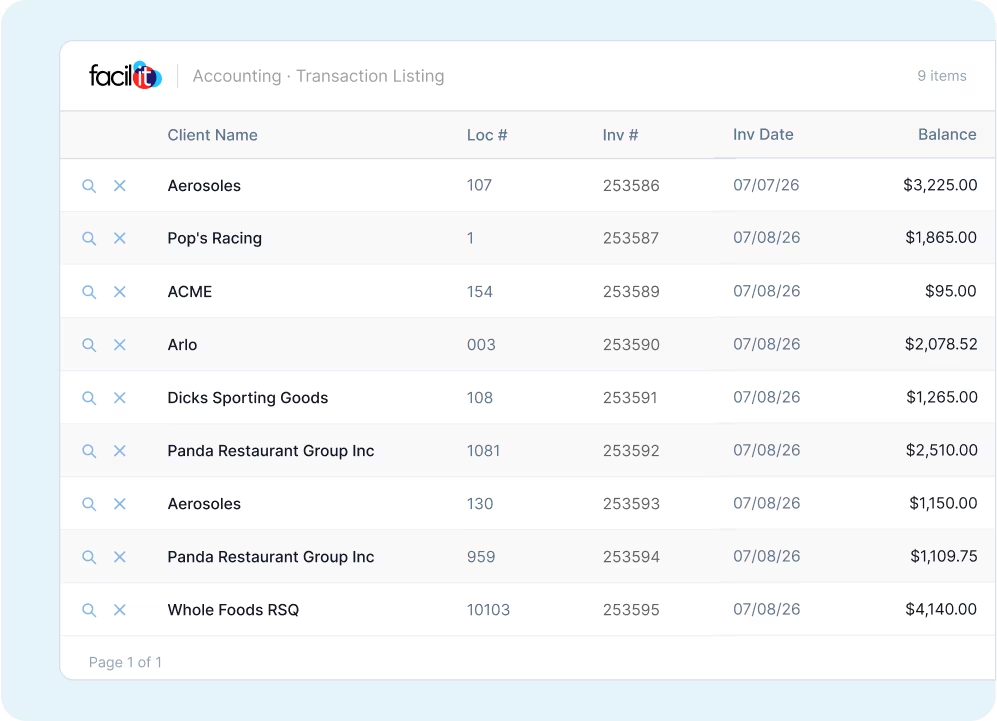
Beyond WebTMA and HEMS, TMA Systems offers solutions for a range of maintenance and asset management needs. MEX and Facil-IT provide CMMS capabilities for managing maintenance, assets, and day-to-day workflows, while ProCal supports calibration management for instruments and related records. Virtual Facility adds AI-enabled building alarm intelligence to help facilities teams turn building system alarms into actionable maintenance workflows.
Together, TMA Systems’ portfolio gives organizations options for different operational requirements, industries, and levels of maintenance complexity.
Proven impact across industries
Across sectors, organizations rely on TMA Systems to strengthen uptime, compliance, and asset performance.
- In enterprise asset management for education, WebTMA helps universities and school districts coordinate maintenance across multiple campuses, improve visibility, and streamline work order management.
- In enterprise asset management for healthcare, hospitals and health systems use WebTMA and HEMS to manage assets, maintain compliance, and support audit readiness.
- In enterprise asset management for manufacturing, production teams use WebTMA to reduce downtime, track performance, and manage equipment lifecycles efficiently.
- In government and public infrastructure, WebTMA supports agencies managing large facility portfolios, transportation assets, and capital projects with transparency and control.
TMA Systems' software supports global operations of every scale, backed by implementation and support teams that deploy systems efficiently, train teams effectively, and sustain long-term reliability.
Questions to ask before choosing the best EAM software
Selecting an enterprise asset management system is a long-term decision that affects how your organization operates, scales, and safeguards its data. The right questions help determine whether a platform can support your team’s daily workflows and future goals.
What deployment model fits our IT strategy?
Start with infrastructure. Decide whether your organization prefers a cloud-based or on-premises solution. Evaluate how each option aligns with your data policies, uptime requirements, and internal security standards.
Does the software integrate with our existing systems?
Integration drives efficiency. Confirm that the platform integrates with ERP, finance, HR, and building management systems to keep asset data accurate and synchronized across departments.
What is the total cost of ownership over five years?
Look beyond the initial subscription. Include costs for implementation, training, maintenance, and ongoing support. A complete financial view helps teams budget effectively and assess long-term return on investment.
What level of support is available during and after implementation?
Ask about deployment timelines, training programs, and post-launch resources. Reliable support helps teams adopt new systems quickly and maintain productivity as operations evolve.
How well do mobile features perform in real-world conditions?
Mobile access matters for teams in the field. Test functionality under typical maintenance scenarios to confirm that technicians can access data, complete work orders, and update records with ease.
Does the platform meet regulatory and compliance standards?
Review the system’s audit capabilities, access controls, and documentation workflows. Compliance-ready features help organizations maintain accountability and data integrity across regulated environments.
These questions guide productive discussions with vendors and internal stakeholders. They help your organization identify platforms that fit its structure, meet its compliance needs, and deliver measurable operational value.
From enterprise asset management software selection to long-term success
The best enterprise asset management systems strengthen reliability across every level of operation. They minimize downtime, simplify compliance, and give leaders the visibility to make informed, data-driven decisions. Long-term success depends on reliable technology, consistent processes, and a partner committed to operational excellence.
Organizations that modernize with enterprise-grade EAM systems often see measurable ROI within the first year, including reduced downtime, optimized maintenance labor, and improved asset utilization.
TMA Systems has supported organizations for more than 30 years with enterprise-ready technology and practical expertise. Our team partners with clients to maintain stability, meet compliance standards, and prepare for future growth.
FAQs for the best enterprise asset management software
Related resources
From ideas to impact
You’ve read the insights, now see how TMA Systems helps teams put them into practice.